A hospital can have advanced surgical equipment, experienced medical professionals and modern patient rooms, yet still experience operational disruption when its cooling, electrical or water infrastructure becomes unavailable.
In Arizona, where healthcare facilities must operate through extreme summer temperatures, dependable building infrastructure is an essential part of healthcare delivery.
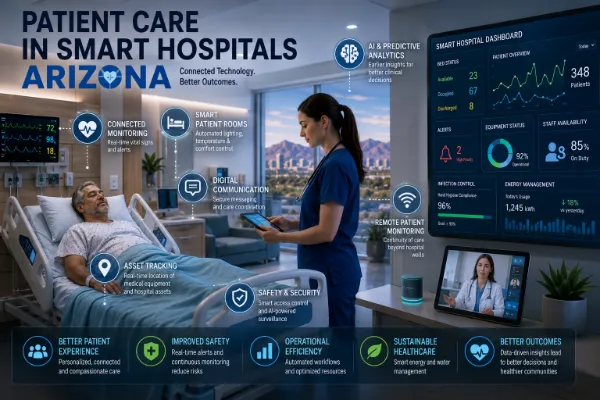
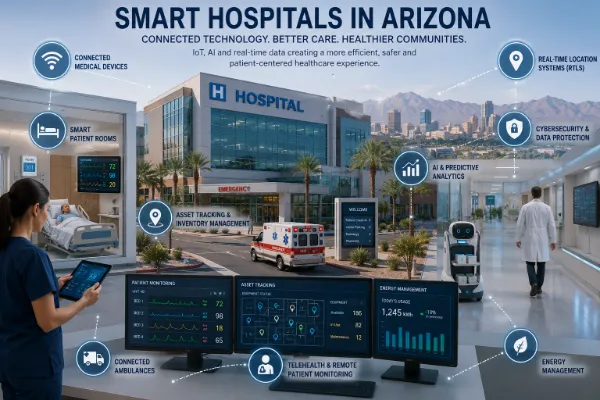
Smart hospitals in Arizona integrate connected medical systems, building automation, environmental sensors, energy management platforms and operational monitoring technologies to support reliable healthcare services.
The objective extends beyond installing connected medical devices. A smart hospital must understand how its clinical, mechanical, electrical and digital infrastructure interact, identify developing operational problems and maintain essential services during disruptions.
Documented modernization projects at the Carl T. Hayden VA Medical Center, Banner Health facilities and expanding medical campuses in Phoenix provide useful examples of how Arizona's healthcare infrastructure is evolving.
A smart hospital is a healthcare facility that uses connected information systems, sensors, automation and analytical technologies to support clinical and operational responsibilities.
However, the number of connected devices does not determine how effectively a hospital operates.
A facility may have thousands of network-connected assets while still experiencing difficulties coordinating maintenance, managing environmental conditions or identifying infrastructure problems.
A more meaningful approach evaluates how effectively connected systems support the hospital's essential functions.
These functions can be divided into several interconnected infrastructure layers.
| Hospital infrastructure layer |
Representative systems |
Operational responsibility |
| Clinical infrastructure |
Medical devices, clinical applications and electronic health records |
Support healthcare delivery and clinical information management |
| Mechanical infrastructure |
Chillers, air handling units, pumps and ventilation equipment |
Maintain appropriate environmental conditions |
| Electrical infrastructure |
Electrical distribution, emergency generators and backup power |
Support essential electrical services |
| Water infrastructure |
Water distribution, storage and treatment equipment |
Maintain water availability and appropriate quality |
| Digital infrastructure |
Hospital networks, servers, gateways and communication systems |
Enable dependable information exchange |
| Operational management |
Building automation, maintenance platforms and monitoring dashboards |
Coordinate equipment performance and operational response |
These layers have different engineering, regulatory and operational requirements. Connecting them does not mean that a single software platform should have unrestricted authority over every hospital function.
Clinical technologies are discussed in our broader guide to healthcare IoT, connected medical devices and hospital asset tracking in Arizona.
Most commercial buildings can temporarily suspend normal operations when their mechanical or electrical infrastructure becomes unavailable.
A hospital may not have the same flexibility.
Intensive care units, operating rooms, laboratories, pharmacies and other clinical departments can depend on environmental conditions and equipment availability that must be maintained according to specific healthcare requirements.
Arizona's summer climate introduces additional operating pressures.
High outdoor temperatures can increase cooling requirements, affect electrical infrastructure and place greater demands on supporting mechanical equipment.
Monsoon-related storms and utility disruptions may also affect electrical service, communications and water infrastructure.
Healthcare facility planning must therefore consider how critical services will continue when individual infrastructure components become unavailable.
The U.S. government's Climate Resilience for Health Care Toolkit provides resources for incorporating climate-related risks into healthcare emergency preparedness and infrastructure planning.
For Arizona hospitals, connected monitoring can support these responsibilities by providing earlier visibility into infrastructure problems. However, monitoring must complement appropriate engineering design, redundancy and emergency response procedures.
Arizona's healthcare facilities already provide documented examples of connected building systems, energy management and infrastructure modernization.
In September 2024, the U.S. Department of Energy published a smart building case study involving the Carl T. Hayden Veterans Affairs Medical Center in Phoenix.
The modernization project combined energy conservation measures with grid-interactive technologies and building control strategies.
According to the Department of Energy, the overall retrofit achieved energy savings exceeding 25 percent and an ENERGY STAR rating of 99.
The project also examined heating, ventilation and air conditioning management, electrical demand and load-shifting opportunities.
Its importance extends beyond the reported savings. It demonstrates that an existing medical facility can improve infrastructure performance through coordinated modernization rather than requiring complete reconstruction.
The reported energy savings relate to the combined retrofit measures. They should not be interpreted as savings attributable exclusively to IoT sensors or building automation software.
Banner Health operates a diverse healthcare facility portfolio that includes buildings with different mechanical equipment, operational requirements and infrastructure configurations.
A case study published by Climatec describes work involving Banner Health's building automation, HVAC controls, central plant optimization and other facility systems.
The reported applications include environmental pressure management for intensive care units and operating rooms, nurse call systems and fire-life safety infrastructure.
This illustrates why healthcare facility modernization requires coordination across several technical disciplines.
Unlike a conventional office automation project, hospital controls must account for clinical environmental requirements, equipment reliability and the responsibilities of healthcare personnel.
The Climatec case study is a contractor-reported implementation and does not independently establish specific improvements in clinical outcomes.
In 2025, Mayo Clinic announced a $1.9 billion investment in its Phoenix campus through its Bold. Forward. Unbound. initiative.
According to the City of Phoenix announcement, the expansion includes approximately 1.2 million square feet of additional development, 11 new operating rooms and 48 additional patient beds.
The initiative also identifies the integration of advanced technology as part of the broader campus modernization.
These are announced development specifications rather than confirmation that every planned facility or technology installation has been completed.
For healthcare infrastructure planners, the project demonstrates the importance of considering mechanical capacity, digital connectivity and clinical requirements together during major facility expansion.
Building automation systems coordinate selected mechanical and electrical functions within a healthcare facility.
In hospitals, these systems may monitor and control air handling equipment, chilled water distribution, ventilation, temperature conditions and other building services.
Local controllers execute approved equipment operating sequences, while supervisory software provides facility teams with equipment status, alarms and historical operating information.
Additional IoT sensors can extend visibility into areas where existing infrastructure provides insufficient information.
However, healthcare facility automation differs from conventional commercial building automation because environmental requirements may depend on the clinical purpose of an individual space.
A general administrative office does not have the same ventilation responsibilities as an airborne infection isolation room or an operating theatre.
Consequently, hospital control systems must preserve approved environmental conditions rather than simply adjust equipment operation according to occupancy or energy consumption.
Our article on building automation systems in Arizona provides a technical explanation of direct digital controllers, communication protocols and supervisory control architecture.
Ventilation infrastructure performs several important functions in healthcare environments, including temperature management, air movement, filtration and the maintenance of appropriate environmental relationships between selected spaces.
The requirements vary according to the healthcare activity taking place within a room.
ANSI/ASHRAE/ASHE Standard 170 addresses ventilation design requirements for healthcare facilities. ASHRAE published the 2025 edition as part of its continuing development of healthcare environmental design standards.
The applicable requirements for an individual hospital depend on the facility type, adopted codes, relevant standard editions and clinical use of each space.
Facility managers can consult the ASHRAE healthcare facilities resources when evaluating relevant design and operational guidance.
Connected carbon dioxide sensors can provide useful information for selected indoor environmental applications.
However, carbon dioxide concentration alone cannot establish that a healthcare space satisfies all applicable ventilation or infection prevention requirements.
Hospitals may also need information about airflow, filtration, temperature, humidity and room pressure relationships.
A monitoring system should therefore collect measurements relevant to the particular healthcare environment instead of relying exclusively on a general indoor air quality score.
Airborne infection isolation rooms use engineered ventilation arrangements intended to help manage the movement of potentially contaminated air.
Appropriate pressure relationships, ventilation performance and monitoring practices are important components of these environments.
Connected differential pressure instruments can support the observation of room conditions. However, a sensor reading alone does not establish that every ventilation or infection prevention requirement has been satisfied.
The CDC's environmental infection control guidance for healthcare facilities explains the importance of appropriate HVAC design, maintenance and monitoring.
Actual environmental settings and corrective actions must be established by qualified facility engineers and infection prevention professionals according to applicable requirements.
Hospital environmental monitoring should be designed around the specific purpose of each clinical and operational space.
| Monitoring application |
Representative measurements |
Operational purpose |
| Operating rooms |
Temperature, humidity and relevant airflow or pressure measurements |
Support approved surgical environmental conditions |
| Airborne infection isolation rooms |
Relevant pressure relationships and ventilation status |
Support appropriate environmental containment arrangements |
| General patient rooms |
Temperature, equipment status and selected environmental measurements |
Support suitable indoor conditions and patient comfort |
| Pharmacy storage |
Temperature and other required storage measurements |
Support appropriate medication storage conditions |
| Laboratories |
Equipment temperature, ventilation and relevant environmental conditions |
Support laboratory operating requirements |
| Electrical and mechanical rooms |
Equipment temperature, moisture and operating status |
Identify infrastructure conditions requiring investigation |
| Data and communication rooms |
Temperature, cooling equipment status and electrical availability |
Support dependable digital infrastructure operation |
These examples are not universal monitoring specifications. Actual measurement requirements depend on equipment, clinical activities and applicable standards.
For general environmental sensing principles, see our guide to air quality monitoring in Arizona.
Hospital cooling infrastructure typically depends on several interconnected mechanical and electrical systems.
A central cooling plant may contain chillers, circulation pumps, heat rejection equipment, control systems and electrical distribution infrastructure.
A problem affecting one component does not necessarily interrupt cooling immediately if suitable redundancy remains available.
However, a failure involving shared infrastructure may affect several departments simultaneously.
Consider a hypothetical Phoenix hospital that experiences an abnormal condition involving its chilled water circulation system during a period of extreme summer heat.
Individual air handling units may continue reporting normal fan operation while the available cooling capacity begins to decline.
If facility managers only monitor whether air handling equipment is running, they may not immediately understand that the underlying cooling service is deteriorating.
Combining chilled water temperatures, flow measurements, equipment operating status and indoor environmental observations can help identify the relationship between the central infrastructure problem and affected hospital areas.
The resulting information can support the facility's established response procedures and help responsible personnel determine which services require attention.
Monitoring cannot independently restore lost cooling capacity. Appropriate equipment redundancy, maintenance practices and contingency planning remain essential.
Our article on smart building heat resilience in Arizona examines similar infrastructure reliability challenges across other building categories.
Healthcare facilities rely on electrical infrastructure for clinical equipment, communication systems, lighting, mechanical equipment and numerous supporting services.
Emergency and standby power systems help maintain designated functions when normal electrical service becomes unavailable.
The Centers for Medicare and Medicaid Services provides emergency preparedness guidance addressing healthcare facility responsibilities during disruptions.
Connected monitoring can support electrical infrastructure management by collecting information about equipment status, electrical loading, generator operating conditions and relevant alarms.
However, the absence of an active generator alarm does not establish that every essential electrical system will operate successfully during an emergency.
Hospitals must continue to conduct applicable inspection, testing and maintenance activities.
A hospital's emergency power capability depends on more than its backup generators.
Relevant infrastructure can include fuel supply arrangements, transfer equipment, electrical distribution, protective devices and the equipment connected to designated electrical circuits.
Digital systems may also depend on uninterruptible power supplies to maintain selected functions during power transitions.
Facility teams should understand which systems require continuous availability, which can tolerate short interruptions and which depend on additional supporting infrastructure.
Remote equipment monitoring can provide useful information between required inspections, but it should not replace approved emergency power verification procedures.
Our remote equipment monitoring guide explains the wider telemetry and diagnostic principles involved in monitoring unattended equipment.
Water infrastructure supports numerous healthcare facility functions, including sanitation, mechanical cooling, cleaning and specialized clinical activities.
Different applications may require different water quality characteristics and supply arrangements.
Consequently, a hospital water management system must consider both infrastructure reliability and the intended use of the water.
Connected water meters, pressure instruments, tank level sensors and moisture detectors can provide information about selected operating conditions.
These measurements may help facility personnel investigate unexpected consumption, identify potential leaks and assess infrastructure availability.
However, a normal water flow reading does not establish that the supplied water satisfies all applicable quality requirements.
Similarly, an automated shutoff system designed for an ordinary commercial property may be unsuitable for healthcare infrastructure that requires continued water availability.
The CDC's Emergency Water Supply Planning Guide for Hospitals and Healthcare Facilities provides a framework for preparing for interruptions to normal water service.
IoT monitoring can support such planning by improving visibility into existing water infrastructure. It does not replace appropriate emergency water supply arrangements or healthcare water management responsibilities.
General water monitoring technologies are compared in our article on water leak detection systems in Arizona.
Healthcare facilities may contain refrigeration equipment used to store medications, vaccines, laboratory materials and other temperature-sensitive products.
These storage applications require monitoring arrangements appropriate to the stored materials and applicable manufacturer or regulatory requirements.
Connected temperature monitoring can help personnel identify abnormal storage conditions and maintain historical environmental records.
A monitoring system may also collect information about equipment communication status, power availability and selected operating alarms.
However, the location and accuracy of a temperature sensor influence the usefulness of its measurements.
Air temperature near a refrigerator door may behave differently from the temperature experienced by materials stored elsewhere within the unit.
Hospitals should evaluate monitoring equipment according to the actual storage requirements rather than assume that any general-purpose wireless thermometer is suitable.
When an abnormal storage condition occurs, qualified personnel must follow applicable procedures for evaluating the affected materials.
Returning refrigeration equipment to its normal operating condition does not automatically establish that previously exposed medications or clinical materials remain suitable for use.
A connected hospital may contain several different technology environments developed for clinical, mechanical and administrative purposes.
Electronic health records, medical device networks, building automation and maintenance systems have different information requirements and operational responsibilities.
Integration should establish which information needs to be shared and which systems remain responsible for individual decisions.
| Hospital technology system |
Primary responsibility |
Useful integration |
| Building automation system (BAS) |
Mechanical and environmental control |
Share selected equipment status and facility alarms |
| Electronic health record (EHR) |
Authorized clinical information management |
Exchange supported clinical and operational records |
| Computerized maintenance management system (CMMS) |
Equipment maintenance and work order management |
Associate verified equipment issues with maintenance activities |
| Real-time location system (RTLS) |
Location information for supported tracked assets |
Support equipment availability and location workflows |
| Energy management information system (EMIS) |
Energy measurement and analysis |
Combine consumption records with relevant facility operating information |
| Hospital operational dashboard |
Coordinated visibility into selected operational conditions |
Present relevant information to authorized teams |
Communication standards such as BACnet can support compatible building automation applications, while healthcare interoperability technologies such as HL7 FHIR address different clinical information exchange requirements.
A hospital does not need to transfer every available measurement into every software platform.
Useful integration should preserve the meaning, timestamp, source and operational ownership of the information being exchanged.
A hospital command center can provide coordinated visibility into selected clinical and operational activities across a facility or healthcare organization.
Depending on its purpose, it may display information concerning hospital capacity, patient movement, equipment availability and operational issues requiring coordination.
Infrastructure monitoring can complement these capabilities by providing authorized personnel with relevant facility information.
For example, a hospital evaluating the availability of a clinical department may need to account for more than the number of unoccupied beds.
The availability of appropriate staff, functioning medical equipment and suitable environmental conditions may also influence whether a space can support its intended clinical activity.
Connected information can help organizations coordinate these responsibilities.
However, an operational dashboard should not independently declare a clinical space suitable for use solely because its connected systems report normal conditions.
Hospital departments must retain the appropriate clinical, technical and regulatory responsibilities for determining operational readiness.
A hospital can receive notifications from physiological monitors, building automation controllers, electrical equipment, refrigeration systems and communication infrastructure.
These notifications serve different purposes and may require responses from different personnel.
A physiological alarm may require clinical assessment, while a mechanical equipment notification may require investigation by facility engineering personnel.
Combining information into an operational platform should not remove these distinctions.
Hospitals should establish who receives each type of notification, how the event is prioritized and when escalation is necessary.
Duplicate notifications from several connected platforms may create confusion without improving awareness.
Similarly, acknowledging an infrastructure alarm does not establish that the underlying equipment problem has been resolved.
Useful alarm management should distinguish detection, acknowledgment, investigation, corrective action and verified resolution.
Patient-facing clinical communication and nurse call workflows are examined separately in our article on smart patient rooms and virtual nursing in Arizona.
Increasing connectivity can improve information availability, but it can also introduce additional dependencies on communication networks and software platforms.
A healthcare facility should understand which functions remain available when an external internet connection, internal network or supervisory application becomes unavailable.
Appropriately designed local building controllers may continue executing approved control sequences during some communication interruptions.
Remote dashboards and centralized analytics may temporarily lose access to current information.
Medical devices and clinical applications have their own operating requirements and must be evaluated according to their intended functions.
A connected hospital should not unnecessarily depend on continuous access to a cloud platform for essential local equipment operation.
Monitoring applications should also distinguish outdated information from current observations.
If a critical environmental sensor stopped reporting several hours earlier, its last recorded normal measurement should not be presented as proof that current conditions remain acceptable.
Local processing and appropriate information retention can support selected monitoring activities during connectivity interruptions.
Our article on edge computing in Arizona explains the architectural principles behind local information processing.
Hospital cybersecurity involves protecting both sensitive healthcare information and the availability of systems required for operational and clinical services.
Connected medical equipment, building automation and administrative information systems may have different security requirements.
Healthcare organizations should establish appropriate network architecture, device inventories, authorized access controls and ongoing software support arrangements.
The U.S. Department of Health and Human Services provides voluntary Healthcare and Public Health Cybersecurity Performance Goals to help organizations prioritize relevant protective practices.
These goals include measures addressing cybersecurity preparedness and the protection of important healthcare assets.
However, a hospital should not assume that installing a firewall, encrypting network traffic or purchasing a security platform independently establishes compliance or operational resilience.
Cybersecurity planning must also account for equipment support lifecycles, clinical continuity and the consequences of unavailable systems.
Changes to connected medical devices and hospital control networks should be coordinated with appropriate healthcare technology, facility and information security professionals.
Additional connected infrastructure considerations are available in our IoT cybersecurity guide for Arizona organizations.
Hospitals can have substantial energy requirements because many clinical and supporting activities operate continuously.
Connected energy monitoring can help facility managers understand electrical consumption, cooling performance and the operating behavior of major equipment.
The Carl T. Hayden VA Medical Center case demonstrates that coordinated infrastructure modernization can provide meaningful energy improvements in a healthcare setting.
However, energy optimization must remain subordinate to applicable clinical and environmental requirements.
An ordinary commercial office may reduce ventilation or cooling during unoccupied periods. The same strategy cannot automatically be applied to healthcare spaces with specific environmental responsibilities.
Facility managers should evaluate energy performance in relation to building function, clinical activity, equipment requirements and outdoor conditions.
Consider a hypothetical hospital cooling system delivering 600 refrigeration tons during a particular operating period.
If its defined cooling production equipment consumes 480 kilowatts, the measured operating efficiency would be 0.8 kilowatts per refrigeration ton.
If the system subsequently delivers the same cooling output while consuming 420 kilowatts under comparable conditions, its measured efficiency would improve to 0.7 kilowatts per ton.
The difference represents 60 kilowatts of electrical demand during the evaluated operating condition.
If that difference were sustained for eight hours, the associated electricity consumption reduction would be 480 kilowatt-hours.
These figures are hypothetical and do not represent measured performance from an Arizona hospital.
Actual evaluation must establish a consistent measurement boundary, including whether pumps, cooling towers and supporting equipment are included.
It should also confirm that required cooling capacity and healthcare environmental conditions remain appropriately maintained.
Our guide to IoT building energy management systems explains the measurement and verification principles involved in evaluating building performance.
The number of connected devices, dashboards and software platforms provides limited information about whether hospital modernization has achieved meaningful improvements.
Healthcare organizations should evaluate connected infrastructure according to the operational problems it was intended to address.
| Evaluation area |
Potential performance indicator |
Operational question |
| Environmental control |
Duration of relevant deviations from approved conditions |
Are required environments maintained dependably? |
| Infrastructure reliability |
Unplanned equipment unavailability |
Are essential supporting services experiencing fewer interruptions? |
| Maintenance performance |
Time to investigate and resolve verified equipment issues |
Can maintenance teams respond more effectively? |
| Monitoring reliability |
Availability of current and valid measurements |
Can responsible personnel trust the information? |
| Energy performance |
Appropriately normalized consumption and equipment efficiency |
Are resources being used more effectively without compromising requirements? |
| Emergency preparedness |
Documented exercise findings and corrective actions |
Can the facility respond appropriately during disruptions? |
| Cybersecurity preparedness |
Asset visibility, recovery readiness and relevant incident findings |
Can connected infrastructure remain dependable during digital disruptions? |
Improvements should be assessed against appropriate baselines and interpreted in the context of changes in facility size, clinical activity and operating conditions.
An improvement in infrastructure performance does not independently establish that a particular technology caused a measurable improvement in clinical outcomes.
Hospital modernization should begin with an understanding of infrastructure dependencies and existing operational problems.
A facility does not necessarily need a new hospital-wide IoT platform before improving its monitoring capabilities.
Existing building automation systems, electrical monitoring equipment and maintenance applications may already contain valuable information that is not being used effectively.
Facility teams should identify which equipment and infrastructure failures could meaningfully affect healthcare services.
They can then determine whether existing measurements, communication interfaces and operational procedures provide sufficient visibility into those risks.
Where information is missing, targeted sensors or appropriate integration work may provide a more practical starting point than replacing an entire system.
Implementation should involve facility engineering, clinical engineering, infection prevention, emergency preparedness, information technology and other relevant healthcare stakeholders.
Before expanding the installation, organizations should verify measurement accuracy, system behavior, notification responsibilities and appropriate operation during relevant failure conditions.
New infrastructure should be maintainable throughout its intended service life, with clear responsibilities for software support, equipment replacement and ongoing verification.
Arizona's healthcare modernization projects demonstrate that smart hospital development involves more than digital patient services or advanced medical equipment.
The connected infrastructure behind healthcare delivery is equally important.
Mechanical systems must maintain appropriate environmental conditions. Electrical systems must support designated essential services. Water infrastructure must remain dependable, and digital networks must support information exchange without introducing unnecessary operational dependencies.
IoT technology can improve visibility across these interconnected systems, helping healthcare organizations identify problems and coordinate maintenance more effectively.
Its value depends on trustworthy measurements, appropriate system integration, qualified professional oversight and established operational procedures.
For Arizona hospitals, the most meaningful measure of a smart facility is not how many devices are connected. It is whether the infrastructure can reliably support the healthcare services that patients and clinical teams depend upon.
Frequently asked questions
A smart hospital uses connected medical systems, building automation, environmental sensors and digital information platforms to support clinical and operational responsibilities. Effective smart hospital infrastructure coordinates these technologies while preserving appropriate safety, reliability and professional oversight.
Arizona healthcare facilities use connected technologies for applications including equipment monitoring, building automation, environmental management and energy optimization. Documented examples include infrastructure modernization at the Carl T. Hayden VA Medical Center and building automation work involving Banner Health facilities.
Smart hospitals use connected information and automation technologies to provide additional operational visibility and integration. Traditional hospitals may also contain advanced medical equipment and building controls. The distinction depends on how effectively relevant systems exchange information and support healthcare operations.
Hospital HVAC infrastructure supports environmental conditions required for clinical and operational activities. Arizona's extreme summer temperatures increase the importance of dependable cooling infrastructure. Connected monitoring can help facility teams investigate equipment problems and environmental deviations.
Some appropriately designed local controllers and equipment systems can continue performing selected functions without continuous internet access. Remote monitoring and cloud services may become unavailable. Hospitals should evaluate system dependencies and maintain appropriate operational continuity arrangements.
Hospitals can use appropriate network architecture, device inventories, access controls, software support and cybersecurity preparedness procedures. Security arrangements should account for the different operational requirements of medical devices, building systems and administrative applications.
Hospital automation and coordinated infrastructure improvements can support more efficient equipment operation and energy management. Actual savings depend on the facility, implemented measures and operating conditions. Energy optimization must preserve applicable clinical and environmental requirements.
Begin by identifying critical infrastructure dependencies, recurring operational problems and gaps in existing monitoring. Evaluate available equipment information and introduce targeted improvements where necessary. Qualified healthcare facility, clinical engineering and technology professionals should verify the resulting system before expansion.
Related articles

 Healthcare IoT