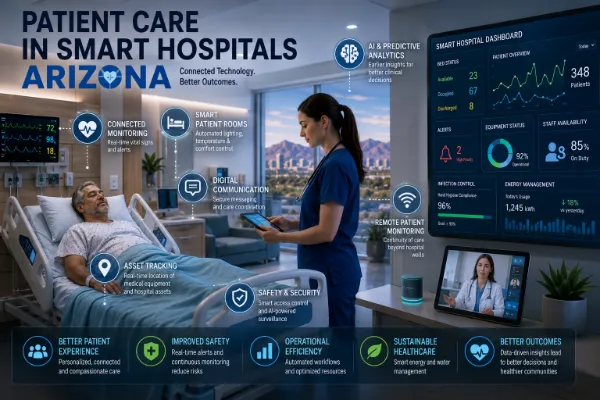
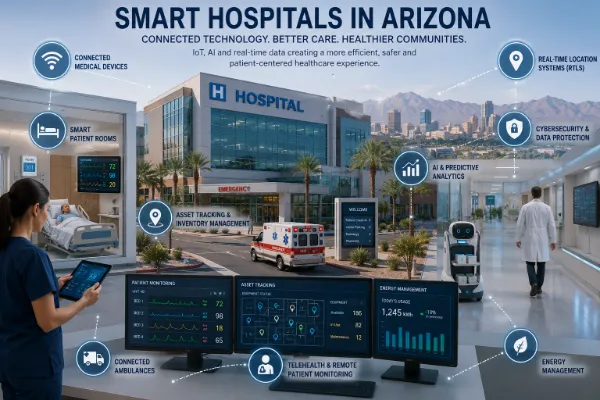
A connected blood pressure monitor in a patient's home and a Bluetooth tracking tag attached to a hospital infusion pump serve fundamentally different purposes. One collects information that may support clinical care, while the other helps healthcare employees locate and manage medical equipment.
Both belong to the expanding ecosystem of IoT in healthcare, where connected devices exchange information with healthcare applications, clinical teams and operational management systems.
In Arizona, these technologies address distinct challenges involving rural healthcare access, geographically dispersed patient populations, extreme summer temperatures and the operational requirements of large hospital systems.
Documented initiatives from Banner Health, Mayo Clinic Arizona and the University of Arizona demonstrate how connected healthcare technology is being applied and investigated locally. However, successful implementation requires more than wireless connectivity. Clinical workflows, measurement reliability, cybersecurity, reimbursement and equipment management must be considered together.
Healthcare IoT refers to connected devices, sensors, communication networks and software used within healthcare environments.
The Internet of Medical Things (IoMT) generally describes connected medical devices and associated technologies that collect, exchange or process health-related information.
Examples include connected blood pressure monitors, medical-grade physiological sensors, infusion pumps and supported wearable monitoring devices.
Healthcare IoT also encompasses operational technologies that may not independently qualify as medical devices, such as equipment location tags, refrigerator temperature sensors and building monitoring systems.
| Technology category |
Representative equipment |
Primary purpose |
| Clinical IoMT |
Connected medical monitors and physiological measurement devices |
Support clinical monitoring and healthcare workflows |
| Remote patient monitoring |
Connected blood pressure monitors, scales and glucose monitoring devices |
Collect selected patient health measurements outside clinical facilities |
| Hospital asset tracking |
RFID tags, Bluetooth beacons and location gateways |
Locate and manage medical equipment |
| Environmental monitoring |
Temperature, humidity and refrigeration sensors |
Monitor facility and storage conditions |
| Connected building infrastructure |
HVAC controllers, electrical meters and facility sensors |
Support hospital infrastructure management |
These systems have different regulatory, technical and operational requirements. A connected equipment tracking tag should not automatically be subject to the same device requirements as a medical monitor used to support clinical decisions.
Our guide to smart hospitals in Arizona examines the broader facility infrastructure connecting these technologies.
Arizona's healthcare delivery environment includes metropolitan hospital networks, rural clinics, tribal healthcare organizations, community hospitals and independent medical practices.
The geographic distribution of these facilities creates different requirements for connected healthcare services.
A rural clinic may prioritize remote patient monitoring because patients travel substantial distances for appointments. A large metropolitan hospital may instead need better equipment visibility across multiple departments and buildings.
Seasonal residents introduce additional continuity-of-care considerations, while remote healthcare programs must account for the availability of reliable communication services at individual patient locations.
Interstate remote care may also involve professional licensing and payer requirements. Maintaining a connected device relationship does not automatically authorize a healthcare provider to deliver every service across state boundaries.
The Arizona Telemedicine Program at the University of Arizona provides resources supporting telemedicine education, collaboration and healthcare technology implementation.
These local conditions make Arizona a relevant environment for investigating connected care, but the appropriate technology depends on the specific population, healthcare organization and clinical service involved.
Remote patient monitoring (RPM) uses connected devices to collect selected health measurements outside conventional healthcare settings and transmit those measurements for review by an appropriate healthcare provider.
Unlike a scheduled video consultation, RPM can provide observations collected between appointments according to the patient's established monitoring plan.
Examples of connected monitoring equipment include:
- Blood pressure monitors for clinician-directed blood pressure tracking.
- Connected scales for selected weight monitoring programs.
- Glucose monitoring devices used according to their approved purpose.
- Pulse oximeters for appropriate oxygen saturation monitoring.
- Compatible cardiac monitoring devices.
- Selected wearable devices supporting defined clinical applications.
Device selection must reflect clinical suitability, measurement accuracy, intended use and the patient's ability to operate the equipment.
Consumer fitness trackers should not automatically be considered equivalent to medical devices used within a formal remote monitoring program.
| Healthcare service |
Primary function |
Representative example |
| Telehealth consultation |
Deliver healthcare services through remote communication |
Scheduled video appointment with a clinician |
| Remote physiologic monitoring |
Collect and review selected physiological measurements |
Connected blood pressure monitoring |
| Remote therapeutic monitoring |
Monitor qualifying therapeutic information and treatment-related activity |
Supported rehabilitation monitoring |
| Hospital-at-home care |
Deliver qualifying hospital-level services in a home environment |
Clinician-managed acute care outside a conventional hospital room |
These services may share technology components, but their clinical requirements, operating responsibilities and reimbursement rules differ.
The U.S. Department of Health and Human Services provides remote patient monitoring implementation guidance for healthcare providers evaluating these services.
Banner Health provides a local example of remote healthcare monitoring through its Virtual Home Monitoring program.
The program connects participating patients with home health nurses and care coordinators while supporting selected ongoing healthcare needs, including heart failure, diabetes and wound recovery.
Its significance extends beyond the use of connected equipment. The monitoring technology operates within a healthcare delivery arrangement involving clinical personnel, patient communication and established care responsibilities.
This distinction is important for healthcare organizations evaluating RPM vendors. Purchasing connected devices does not independently create an effective remote care program.
Healthcare providers must establish who reviews incoming measurements, how abnormal observations are assessed, when patients are contacted and how relevant information is documented.
Banner Health's publicly described program demonstrates an established local application. It does not establish that every remote monitoring deployment will produce identical clinical outcomes, staffing requirements or financial benefits.
A remote monitoring system involves several stages between collecting a measurement and using it within a clinical workflow.
- Patient measurement: A suitable medical device collects the prescribed physiological observation.
- Device identification: The system associates the measurement with the appropriate device and patient record.
- Data transmission: Cellular, Wi-Fi or Bluetooth-enabled infrastructure transfers the observation to an authorized platform.
- Measurement validation: Software and designated personnel evaluate data completeness, timestamps and potential measurement problems.
- Clinical review: Appropriate healthcare professionals interpret the information according to the monitoring plan.
- Documentation and follow-up: Relevant observations and clinical actions are recorded through established healthcare workflows.
A missing measurement does not necessarily indicate a change in a patient's health. It may result from a communication interruption, device malfunction, missed measurement or incorrect device use.
Similarly, an abnormal reading requires interpretation in its clinical context. Remote monitoring software should not independently make treatment decisions outside its intended and authorized functionality.
Patients should also understand whether their monitoring program provides scheduled review or continuous clinical supervision. RPM should not be assumed to provide emergency response or around-the-clock observation.
Reimbursement is an important consideration for healthcare organizations establishing remote monitoring services.
Medicare, Arizona Medicaid and commercial insurers may apply different eligibility, documentation and billing requirements.
Current Centers for Medicare and Medicaid Services remote patient monitoring guidance describes the use of connected medical devices that automatically transmit physiological information to healthcare providers.
CMS guidance also recognizes device supply arrangements involving at least two readings during a 30-day period, subject to applicable billing requirements.
This does not mean that collecting two measurements automatically qualifies an organization for every RPM billing code. Different service categories can have separate requirements involving device use, treatment management, documentation and clinical communication.
The Arizona Health Care Cost Containment System (AHCCCS) includes remote patient monitoring within its telehealth framework.
Healthcare organizations should review current AHCCCS medical policies, applicable code sets, provider requirements and managed care arrangements before developing reimbursement assumptions.
Medicare coverage requirements should not automatically be applied to Arizona Medicaid or commercial insurance plans.
Our analysis of heat-season remote patient monitoring in Arizona examines the relationship between seasonal monitoring needs and newer RPM service arrangements in greater detail.
Remote patient monitoring can introduce additional workload when incoming observations require clinical review, documentation, patient communication or technical troubleshooting.
Before enrolling a large patient population, healthcare organizations should estimate the staffing capacity required to manage that information.
Consider a hypothetical clinic enrolling 200 patients into a monitoring program. Assume each patient is scheduled to submit one measurement session per day and that the review process averages two minutes per session.
| Planning assumption |
Illustrative value |
| Enrolled patients |
200 |
| Expected measurement sessions per day |
200 |
| Average review time per session |
2 minutes |
| Daily review workload |
400 minutes |
| Equivalent daily review time |
Approximately 6.7 hours |
This calculation excludes patient calls, documentation, technical support, escalations, meetings, absences and other clinical responsibilities.
These are hypothetical staffing assumptions, not recommended clinical review durations, reimbursement calculations or actual Banner Health performance results.
The example demonstrates why RPM enrollment targets should be evaluated alongside the available clinical workforce. A program that successfully transmits measurements but lacks sufficient review capacity may fail to deliver its intended operational value.
Hospital employees frequently depend on mobile equipment that moves between patient rooms, treatment areas, storage locations and maintenance departments.
Examples include infusion pumps, portable monitors, wheelchairs, beds and other reusable medical equipment.
A conventional inventory database may establish that an organization owns a particular device without identifying its current or last observed location.
Hospital asset tracking systems connect physical equipment identifiers with location observations and operational software.
Depending on the implementation, these systems can help employees investigate equipment availability, maintenance requirements, inventory discrepancies and movement between departments.
However, knowing where an infusion pump is located does not necessarily establish whether it is clean, clinically available or ready for patient use.
Equipment location must be interpreted alongside maintenance status, infection prevention procedures and applicable operational records.
Hospital tracking technology should be selected according to the required location accuracy, reporting frequency, equipment characteristics and installation environment.
| Tracking technology |
Typical healthcare application |
Important limitation |
| Barcode identification |
Manual inventory verification and equipment identification |
Generally requires deliberate scanning |
| Passive RFID |
Equipment identification at compatible reading locations |
Does not automatically provide continuous asset location |
| Bluetooth Low Energy (BLE) |
Battery-powered equipment tags and zone-level location monitoring |
Accuracy depends on receiver placement and system design |
| Wi-Fi-based RTLS |
Location estimation for compatible connected assets |
Performance depends on infrastructure and calibration |
| Ultra-wideband (UWB) |
Higher-precision indoor location applications |
Requires suitable anchors and supporting infrastructure |
| Infrared location systems |
Selected room-level location applications |
May depend on suitable signal paths and receiver placement |
A real-time location system (RTLS) may use one or several of these technologies. RTLS describes the location capability rather than a single wireless communication protocol.
Healthcare organizations should establish whether they require building-level, floor-level, room-level or more precise positioning before selecting equipment.
Location accuracy should be tested under actual hospital conditions, including equipment movement, closed doors, changing room configurations and potential radio interference.
Industry reporting provides a documented example of connected location technology at Mayo Clinic's Arizona campuses.
A published Mayo Clinic RTLS implementation report describes Bluetooth-based receivers, asset beacons and Wi-Fi gateways operating within its wider location infrastructure.
The report identifies connected equipment at both the Phoenix and Scottsdale campuses.
Location infrastructure can support different operational applications, including asset management and staff assistance systems, when the underlying devices and workflows are configured for those purposes.
Because this information comes from industry implementation reporting, it should not be treated as an independently verified assessment of clinical outcomes or financial returns.
Nevertheless, it provides a useful Arizona-specific example of how connected location technology can extend beyond experimental healthcare applications.
Hospital equipment tracking projects should be evaluated against measurable operational problems rather than generalized claims about time savings.
Consider a hypothetical hospital department where 40 equipment searches take place each working day.
Assume a baseline average search duration of six minutes and a subsequent average of two minutes following an asset tracking and workflow improvement project.
| Performance indicator |
Before deployment |
After deployment |
| Equipment searches per day |
40 |
40 |
| Average search duration |
6 minutes |
2 minutes |
| Total daily search time |
240 minutes |
80 minutes |
| Equivalent daily staff time |
4 hours |
Approximately 1.3 hours |
The illustrative improvement recovers 160 minutes of staff time per day.
Across 250 operating days, this represents approximately 667 hours of potentially recovered staff time.
Recovered staff time does not automatically represent an equivalent reduction in payroll expenditure. Its financial and operational value depends on whether that time can be redirected toward other necessary activities.
These figures are hypothetical and do not represent measured results from Mayo Clinic, Banner Health or another Arizona healthcare provider.
The calculation provides a framework that hospital administrators can adapt using their own equipment search observations and validated operational measurements.
Connected medical devices often generate information in proprietary formats. Healthcare organizations must determine how that information will enter existing clinical and operational applications.
Fast Healthcare Interoperability Resources (FHIR), developed by HL7 International, provides a standardized framework for exchanging healthcare information.
The FHIR Observation resource supports the representation of clinical observations and measurements, including vital signs.
The FHIR Device resource supports information describing medical devices and their relevant attributes.
| Healthcare application |
Relevant information |
Integration objective |
| Electronic health record (EHR) |
Patient observations and clinical documentation |
Support authorized clinical review |
| Remote monitoring platform |
Device measurements and monitoring activity |
Coordinate patient monitoring workflows |
| Hospital asset management system |
Equipment identity, location and availability |
Improve equipment visibility |
| Maintenance management system (CMMS) |
Inspection history and maintenance status |
Coordinate clinical engineering activities |
| Building management system (BMS) |
Facility environmental and equipment information |
Support infrastructure operation |
FHIR compatibility does not automatically establish successful interoperability between every medical device and electronic health record platform.
Organizations must verify supported FHIR versions, implementation profiles, patient identification methods, measurement units, authorization arrangements and actual data exchange capabilities.
Integration should also establish which information belongs in the clinical record and which information is more appropriately retained within operational management applications.
These distinctions support the clinical workflows discussed in our guide to connected patient care in Arizona smart hospitals.
Remote patient monitoring depends on reliable communication between the patient's device and the healthcare platform.
Arizona's geographically dispersed communities require healthcare organizations to evaluate connectivity at actual deployment locations rather than rely exclusively on statewide coverage maps.
| Connectivity option |
Representative application |
Deployment consideration |
| Cellular-connected medical device |
Direct transmission of supported patient measurements |
Actual carrier coverage and device service arrangements |
| Bluetooth |
Communication between a device and a nearby phone or gateway |
Pairing reliability and patient ability to operate equipment |
| Home Wi-Fi |
Supported home monitoring and telehealth devices |
Broadband availability and network configuration |
| Enterprise Wi-Fi |
Compatible hospital equipment and mobile clinical devices |
Coverage, security, capacity and roaming performance |
| LoRaWAN |
Selected noncritical facility and environmental monitoring |
Reporting frequency and application-specific suitability |
Cellular connectivity may reduce reliance on a patient's home internet connection, but it is not a universal solution for every rural location.
Healthcare teams should establish procedures for missed transmissions, device support and alternative communication when connected equipment becomes unavailable.
Local data storage may help preserve compatible observations during temporary network interruptions. However, delayed measurements must not be presented to clinicians as current without appropriate timestamp information.
Further network planning considerations are covered in our Arizona IoT connectivity guide.
Connected healthcare devices can introduce cybersecurity risks affecting patient information, medical equipment availability and clinical operations.
These risks require attention throughout the device lifecycle, including procurement, installation, operation, maintenance and eventual retirement.
In February 2026, the FDA issued updated guidance titled Cybersecurity in Medical Devices: Quality Management System Considerations and Content of Premarket Submissions.
The guidance addresses cybersecurity-related device design, labeling and documentation recommendations for manufacturers and relevant premarket submissions.
Healthcare organizations evaluating connected medical devices should also consider their own operational responsibilities rather than assume manufacturer compliance resolves every cybersecurity risk.
Important procurement and operational considerations include:
- Maintaining an accurate inventory of connected medical devices.
- Controlling access to clinical and operational networks.
- Evaluating manufacturer security update arrangements.
- Establishing supported device maintenance procedures.
- Reviewing software support and equipment end-of-life policies.
- Protecting sensitive information during transmission and storage.
- Maintaining appropriate incident response and continuity procedures.
Healthcare organizations subject to HIPAA must evaluate how their technology providers create, receive, maintain or transmit protected health information.
HHS provides HIPAA guidance for telehealth technology, including requirements concerning applicable business associate relationships.
Where a technology vendor performs qualifying business associate functions, an appropriate business associate agreement may be required.
Encryption alone does not establish HIPAA compliance. Access management, risk assessment, organizational procedures and other applicable safeguards must also be considered.
Healthcare organizations can apply the broader infrastructure principles discussed in our IoT cybersecurity guide for Arizona, while maintaining healthcare-specific security and clinical safety requirements.
Arizona's healthcare technology ecosystem also includes research infrastructure supporting the evaluation of emerging connected health technologies.
The University of Arizona's Digital Health Technology and Sensor Core provides researchers with access to specialized sensors, mobile health technologies and data analysis resources.
These capabilities support investigations into how connected technologies can be applied within healthcare and related research environments.
The distinction between research and established clinical deployment is important. A promising sensor prototype does not automatically establish clinical effectiveness, regulatory authorization or suitability for routine patient care.
Healthcare technology providers should evaluate the intended use, measurement reliability and supporting evidence for each proposed application.
A healthcare IoT project should begin with a clearly identified clinical or operational problem.
For a clinic, this may involve insufficient information between patient appointments. For a hospital department, it may involve excessive time spent locating reusable equipment.
| Evaluation area |
Remote patient monitoring |
Hospital asset tracking |
| Primary objective |
Support defined clinical monitoring needs |
Improve equipment visibility and availability |
| Device selection |
Clinical suitability and measurement reliability |
Location accuracy and equipment compatibility |
| Operational ownership |
Authorized clinical and care coordination teams |
Clinical engineering and equipment management teams |
| Data integration |
Relevant healthcare records and monitoring platforms |
Asset management and maintenance software |
| Performance indicators |
Usable measurements, enrollment and appropriate clinical follow-up |
Equipment search time, location accuracy and availability |
| Privacy considerations |
Patient information and clinical communication |
Equipment records and any associated staff or patient location information |
| Financial evaluation |
Clinical staffing, device costs and applicable reimbursement |
Equipment expenditure, staff time and operational improvements |
A representative pilot can help establish whether the technology provides reliable information and integrates effectively with existing healthcare operations.
Clinical outcomes should be evaluated using appropriate study methods and healthcare expertise rather than inferred directly from device activity or platform usage.
Arizona's documented remote monitoring programs, connected hospital infrastructure and academic research demonstrate several practical applications of healthcare IoT.
The most valuable deployments are those that connect appropriate measurements with established clinical or operational responsibilities. Technology can improve access to information, but healthcare outcomes and equipment management improvements depend on how reliably and responsibly that information is used.
Frequently asked questions
Healthcare IoT refers to connected devices, like monitors, sensors, and tags, that automatically collect and transmit data. Telehealth typically refers to live video or phone visits. The two often work together, with IoT devices supplying the data a clinician reviews during or between virtual visits.
Many payers, including Medicare, cover structured remote monitoring programs when they meet documentation requirements around device data collection and clinical review time. Coverage details vary by payer and program, so clinics should verify specific billing codes with their compliance team before launching a program.
Smaller facilities often can't afford to buy duplicate equipment for every unit just in case something goes missing. Location tracking improves utilization of the equipment already on hand, which can reduce the need for additional purchases and free up staff time otherwise spent searching for devices.
Parts of northern and southeastern Arizona have limited broadband or cellular coverage. Clinics should test connectivity at a patient's actual home address and favor devices with cellular data plans built in rather than relying solely on home WiFi.
Security depends on choosing devices and platforms that integrate properly with existing IT security policies, including encrypted data transmission and access controls tied to the electronic health record. IT and compliance teams should be involved before any device is selected, not after.
Start with a narrow pilot, such as remote monitoring for one chronic condition or asset tracking for one equipment type on one unit. This produces usable data on staffing needs and financial impact before committing to a larger rollout.
Related articles

 Healthcare IoT