When a flash flood develops in Pima County, a wildfire threatens a northern Arizona community or a power failure disrupts a Phoenix commercial building, detecting the problem is only the beginning. Emergency managers must determine who is affected, which instructions are appropriate and how to communicate those instructions before conditions deteriorate.
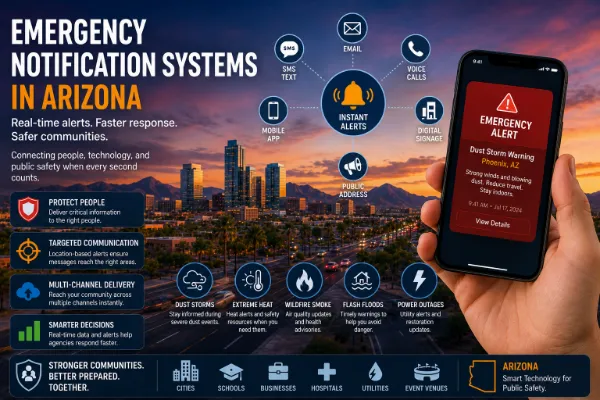
Emergency notification systems in Arizona combine mass communication software, geographic targeting, public warning networks, connected sensors and emergency management procedures. These systems help municipalities, schools, businesses, utilities and healthcare facilities distribute time-sensitive information through multiple communication channels.
Arizona already has documented examples of statewide emergency notification infrastructure and sensor-supported flood warning systems. Understanding how these systems operate provides a practical foundation for organizations evaluating modern emergency communication technology.
Emergency communication in Arizona involves multiple levels of government, local emergency management departments, public safety answering points, federal warning infrastructure and independently operated organizational notification systems.
These systems serve different audiences and operate under different authorization requirements.
The Arizona Department of Administration's State 9-1-1 Program has implemented the Rave emergency notification platform to support public safety answering points across Arizona.
According to the state's Rave citizen registration information, the system was designed to serve 81 public safety answering points.
The platform supports emergency communications through text messages, email and voice notifications. Registration allows participants to establish contact information and select available notification preferences.
This statewide procurement illustrates how shared technology infrastructure can support emergency communication across multiple public safety jurisdictions without requiring each participating agency to independently develop an entire notification platform.
The Maricopa County emergency notification service uses Rave Alerts to provide customized notifications to people who live, work, travel through or visit the county.
Registered users can receive information through supported communication channels, including telephone calls, text messages and email.
These registration-based notifications complement broader public warning mechanisms such as Wireless Emergency Alerts and emergency broadcasts.
Pima County operates the MyAlerts emergency notification service, which provides emergency information to registered participants.
One particularly relevant application involves flood-related messaging. The county's Regional Flood Control District and Office of Emergency Management use MyAlerts to provide near-real-time flood notifications within selected watersheds.
This demonstrates a practical connection between environmental monitoring infrastructure and emergency communication.
Emergency communication terminology can be confusing because several different technologies are frequently described using similar names.
A corporate mass notification platform does not necessarily have the authority or technical capability to distribute official public warnings. Likewise, a government emergency alert platform may not provide all the internal communication functions required by a hospital or industrial facility.
| System type |
Primary audience |
Typical function |
| Emergency notification system (ENS) |
Defined communities or organizations |
Distribute emergency messages and instructions |
| Mass notification system (MNS) |
Employees, students, residents or other large groups |
Coordinate communication across multiple delivery channels |
| Wireless Emergency Alerts (WEA) |
Compatible mobile devices within an affected geographic area |
Deliver authorized public emergency warnings |
| Emergency Alert System (EAS) |
Radio and television audiences |
Distribute official emergency broadcasts |
| Building emergency communication system |
People occupying a particular facility |
Provide audible, visual or other emergency instructions |
| Operational IoT alert platform |
Maintenance, engineering and safety personnel |
Communicate abnormal equipment or environmental conditions |
An organization may require several of these capabilities. For example, a hospital might need internal employee notifications, building emergency communication, equipment alarms and procedures for receiving official public warnings.
These functions should be coordinated without assuming that a single software application can replace every existing life-safety or emergency communication system.
A connected emergency notification system converts information about physical conditions into communication that supports an appropriate response.
The architecture generally involves five functional stages.
Information may originate from environmental sensors, equipment monitoring systems, weather services, utility infrastructure, authorized personnel or emergency dispatch operations.
For example, connected water-level sensors may identify unusual stream conditions, while a building monitoring platform may report abnormal temperatures or equipment failures.
Sensor readings must be evaluated according to their reliability, measurement limitations and operational context.
A single abnormal measurement does not necessarily establish that an emergency exists. Equipment malfunction, communication errors and environmental influences can produce misleading observations.
Appropriate verification procedures help distinguish maintenance problems from conditions requiring emergency communication.
The organization determines the appropriate message category, affected audience and communication urgency.
Some operational alerts can be generated automatically under approved procedures. Public warnings and consequential emergency instructions require suitable authorization, established policies and safeguards.
The notification platform distributes the approved information through selected communication channels. These may include mobile messaging, telephone calls, email, applications, digital signage or building communication systems.
Emergency management teams review available delivery information, investigate communication failures and distribute subsequent updates as necessary.
For systems supporting acknowledgments, responses can provide additional information about recipient status. However, successful message transmission does not independently confirm that a person received, understood or acted upon the instructions.
This distinction is fundamental to effective public safety IoT infrastructure in Arizona.
The Integrated Public Alert and Warning System, commonly known as IPAWS, provides infrastructure through which authorized alerting organizations distribute emergency information across participating public communication systems.
IPAWS is not simply a mobile application or an ordinary SMS messaging service. It connects approved alert originators with established warning distribution infrastructure.
Participating communication pathways include Wireless Emergency Alerts, the Emergency Alert System and other compatible public warning services.
| IPAWS component |
Function |
| Authorized alerting organization |
Determines whether an official warning should be issued |
| Alert origination software |
Creates and submits emergency message information |
| Common Alerting Protocol |
Provides standardized emergency message formatting |
| IPAWS infrastructure |
Supports authenticated distribution through participating systems |
| Communication channels |
Deliver supported warnings to public audiences |
FEMA provides dedicated IPAWS training for alert originators, covering message development, distribution, operational procedures and effective public warning practices.
Organizations purchasing emergency notification software should verify whether the product supports official public alerting and whether their organization possesses the required authorization. Purchasing compatible software does not automatically grant permission to issue public emergency warnings.
Emergency information often needs to move between organizations, software platforms and communication networks.
The Common Alerting Protocol (CAP) provides a standardized format for exchanging emergency information across compatible systems.
CAP allows an alert to include structured information describing the event, issuing organization, geographic area, urgency, severity, certainty and relevant instructions.
| CAP information element |
Operational purpose |
| Event information |
Identifies the emergency or warning category |
| Sender |
Identifies the organization originating the message |
| Urgency |
Describes how promptly action is required |
| Severity |
Characterizes the potential consequences |
| Certainty |
Describes confidence in the reported condition |
| Geographic area |
Defines the intended affected location |
| Instructions |
Communicates recommended protective actions |
| Expiration information |
Identifies when the alert is expected to become inactive |
| Message references |
Supports relationships between original alerts, updates and cancellations |
The official OASIS Common Alerting Protocol version 1.2 specification defines the message structure used by compatible emergency information systems.
For Arizona municipalities, CAP compatibility can help reduce integration difficulties between notification software, emergency management applications and other supported information systems.
However, CAP compatibility alone does not guarantee that every platform supports identical features, message extensions or distribution channels.
Wireless Emergency Alerts and ordinary emergency text messages may appear similar to mobile phone users, but their underlying delivery mechanisms differ.
| Feature |
Wireless Emergency Alerts |
SMS mass notifications |
| Delivery mechanism |
Participating cellular broadcast infrastructure |
Messages addressed to individual telephone numbers |
| Registration |
Generally does not require local notification registration |
Typically requires available contact information |
| Geographic targeting |
Supported public warning areas |
Depends on available address or recipient information |
| Sending authority |
Authorized public alert originators |
Organizations using approved messaging platforms |
| Recipient acknowledgment |
Not designed for individual response tracking |
May support responses through compatible platforms |
| Typical application |
Official warnings about qualifying public emergencies |
Community updates, employee alerts and organizational communication |
Wireless Emergency Alerts can reach compatible phones within an affected area, including some visitors who have not registered with a local notification service.
Registration-based SMS systems provide different advantages, including communication with known recipients who may be outside the immediate incident area.
For example, an organization may need to notify employees about a facility closure before they begin traveling to work.
The Maricopa County Wireless Emergency Alerts information page provides guidance on how these public warnings operate.
Using complementary communication methods can improve notification coverage, but no individual method guarantees delivery to every affected person.
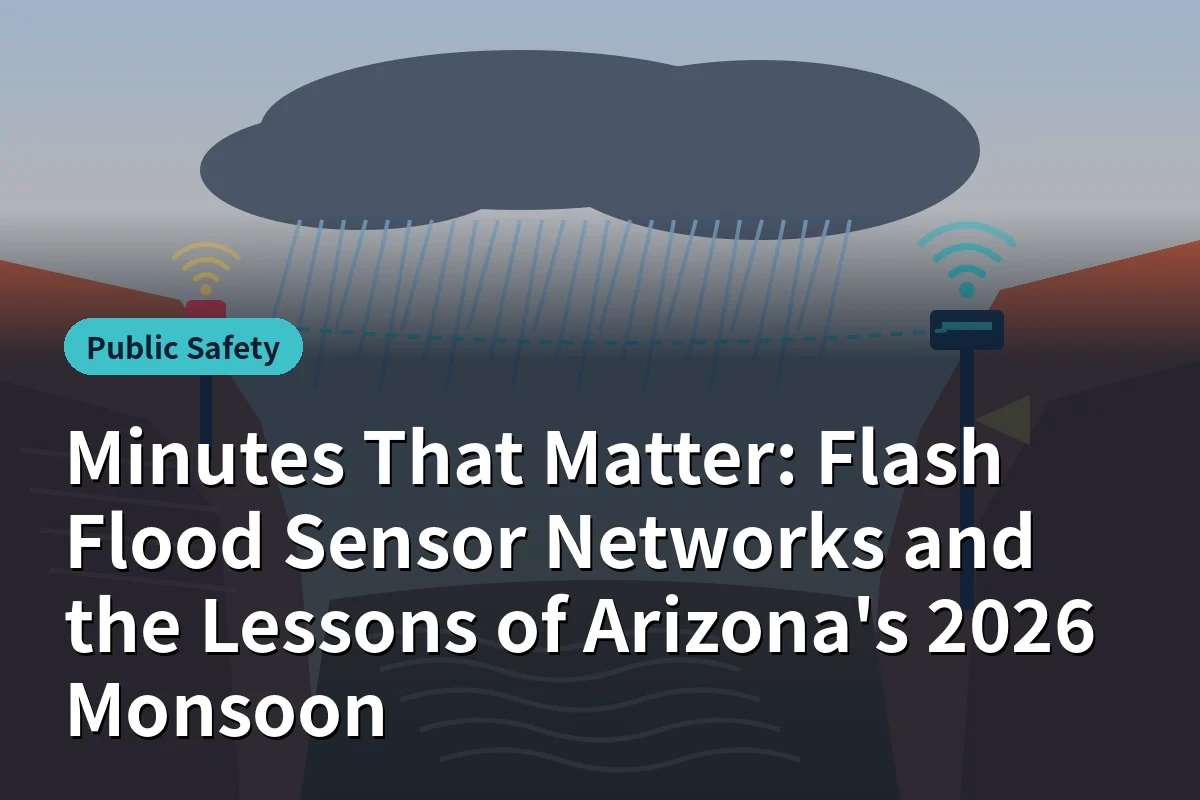
One of Arizona's strongest examples of connected environmental monitoring supporting emergency communication comes from Pima County's flood warning infrastructure.
The county maintains an Automated Local Evaluation in Real Time network, commonly referred to as ALERT, for collecting precipitation and streamflow information.
According to its precipitation and streamflow monitoring documentation, field stations transmit measurements through radio telemetry to receiving infrastructure, including facilities associated with emergency management and the National Weather Service.
The resulting observations help describe changing watershed conditions.
Separately, Pima County's MyAlerts flood messaging program provides near-real-time notifications to registered residents in selected watersheds.
Together, these capabilities illustrate the relationship between environmental measurements, emergency management information and public communication.
Precipitation measurements and stream-level readings describe conditions at specific monitoring locations. They may not fully represent conditions at every downstream road crossing, neighborhood or drainage channel.
Flood warning procedures therefore need to account for local watershed behavior, measurement reliability, forecast information and established emergency management responsibilities.
Our guide to Arizona flash flood sensor warning networks examines the detection infrastructure in greater detail.
The emergency notification layer serves a complementary purpose: communicating relevant information to the people and organizations affected by the developing conditions.
Arizona faces a combination of environmental, transportation and infrastructure hazards. Notification systems should reflect the communication requirements associated with each event rather than distribute identical messages for every incident.
| Arizona hazard |
Relevant information source |
Notification objective |
| Flash flooding |
Weather warnings, rainfall stations and stream monitoring |
Communicate affected locations and official protective instructions |
| Dust storms |
National Weather Service warnings and transportation observations |
Warn affected travelers and support transportation safety communication |
| Wildfires |
Fire authorities and emergency management agencies |
Communicate evacuation status and verified updates |
| Extreme heat |
Official heat warnings and environmental measurements |
Provide preparedness information and access to cooling resources |
| Wildfire smoke |
Air quality monitoring and official advisories |
Communicate relevant exposure information |
| Electrical outages |
Utility monitoring and verified service information |
Coordinate operational responses and customer communication |
| Industrial incidents |
Facility monitoring systems and authorized safety personnel |
Provide approved instructions to affected workers and organizations |
The National Weather Service publishes examples of weather warnings distributed through Wireless Emergency Alerts, including qualifying flash flood and dust storm warnings relevant to Arizona.
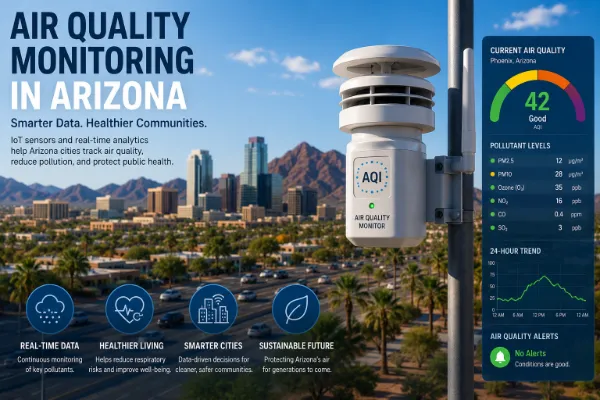
Organizations can also use supplemental data from connected air quality monitoring systems and extreme heat monitoring infrastructure to investigate local conditions.
Supplemental measurements should not be represented as official weather or public health warnings unless issued through the appropriate authorized processes.
Arizona's official Ready, Set, Go! program provides a common emergency preparedness and evacuation communication framework.
The Arizona Emergency Information Network explains the three stages used to help communities understand changing emergency conditions.
| Stage |
General meaning |
Communication objective |
| READY |
Prepare for possible emergencies |
Communicate preparedness resources and relevant hazards |
| SET |
Remain alert to significant potential danger |
Provide developing incident information and preparation guidance |
| GO |
Immediate evacuation due to current life-threatening danger |
Communicate official evacuation instructions promptly |
Emergency notification platforms should support established terminology rather than introduce competing classifications that could confuse recipients.
Consistent terminology becomes particularly important when people receive information from county agencies, municipal departments, news organizations and social media at approximately the same time.
Residents should register with their applicable county or tribal notification service and follow instructions issued by the responsible emergency authorities.
Educational institutions have communication requirements that extend beyond notifying everyone on a single contact list.
Students, faculty, administrators, transportation personnel, parents and visitors may require different information during the same incident.
A school closure notice, for example, serves a different purpose from an immediate building safety instruction or a subsequent family reunification update.
When evaluating school emergency notification systems, administrators should consider contact information accuracy, audience segmentation, accessible communication channels, message approval procedures and integration with established emergency plans.
Outdoor activity changes associated with extreme heat or unhealthy air quality may also require coordination between administrators, athletic departments and transportation teams.
Connected environmental information can support these decisions, but institutions should follow applicable safety policies and official guidance rather than depend exclusively on automated sensor thresholds.
Arizona manufacturing facilities, distribution centers and commercial properties frequently contain multiple operating zones with different communication requirements.
Employees working near machinery may not reliably hear a conventional announcement. Outdoor workers may not have access to desktop notifications. Visitors and contractors may not appear in the organization's employee contact database.
A mass notification system for businesses should therefore be designed around the physical operating environment and the people who need to receive information.
Potential communication channels include mobile messages, audible announcements, visual notification devices, workstation notifications and compatible building communication infrastructure.
Industrial facilities can also integrate selected notifications with warehouse sensor networks and industrial IoT monitoring systems.
These integrations can help route equipment abnormalities and environmental observations to appropriate operational teams.
A connected vibration sensor reporting abnormal motor operation should ordinarily initiate an equipment investigation or maintenance response. It should not automatically generate a facility-wide emergency notification unless an approved safety procedure establishes that requirement.
Likewise, ordinary cloud-based messaging software should not be treated as a replacement for required fire alarms, emergency voice communication equipment or other regulated life-safety systems.
The NFPA 72 National Fire Alarm and Signaling Code addresses fire alarm and emergency communication requirements.
Facility owners should consult qualified fire protection professionals and the applicable authority having jurisdiction when evaluating required emergency communication systems.
Connected building infrastructure can generate alerts involving water leaks, equipment failures, electrical interruptions and environmental conditions.
However, the appropriate notification audience varies according to the nature of the event.
A minor water leak may require a facilities maintenance notification, while a verified building emergency may require communication with occupants and emergency personnel.
Integration with building automation systems in Arizona allows selected equipment and environmental events to enter appropriate operational workflows.
Utilities face similar requirements. Grid monitoring systems can identify infrastructure abnormalities, but customer communications should reflect verified service conditions and established utility procedures.
For example, smart electric grid infrastructure can provide information that supports outage investigation and restoration coordination.
Emergency notification software should receive information from these systems through controlled integrations that preserve the distinction between preliminary equipment observations and confirmed incidents.
Communication reliability depends on more than the availability of the notification platform itself.
A message can fail to reach its intended recipient because of outdated contact information, unavailable mobile coverage, depleted device batteries, inaccessible message formats or communication infrastructure interruptions.
| Communication channel |
Primary advantage |
Potential limitation |
| SMS |
Reaches registered mobile numbers without requiring a dedicated application |
Delivery can be affected by network conditions and contact accuracy |
| Voice calls |
Provides audible communication through supported telephone services |
Recipients may not answer or recognize the caller |
| Email |
Supports detailed instructions and follow-up information |
Messages may not be reviewed immediately |
| Mobile application notifications |
Supports rich information and configured audience targeting |
Requires compatible devices and notification permissions |
| Public address systems |
Communicates with people within an occupied facility |
Audibility and intelligibility vary by location |
| Digital signage |
Provides visible instructions in public and commercial spaces |
Requires power and sufficient visibility |
| Official emergency broadcasts |
Distributes public warnings through established channels |
Subject to applicable authorization and distribution requirements |
Effective emergency communication uses complementary methods selected according to the audience and event.
The objective is not simply to send identical information through every available channel. It is to provide consistent, appropriate instructions through methods that affected people can reasonably access.
Monsoon storms, electrical interruptions, remote operating locations and infrastructure failures can affect the communication networks used by emergency notification systems.
A notification platform may remain operational while individual field sensors, communication gateways or recipient devices become unavailable.
System designers should evaluate backup power, alternative communication pathways, local operating capabilities and documented recovery procedures.
For distributed monitoring devices, IoT connectivity planning in Arizona should account for actual geographic coverage and the communication requirements of each application.
Local processing through edge computing infrastructure can support selected equipment monitoring and local functions when a remote cloud platform becomes temporarily unavailable.
Emergency communication redundancy should also be evaluated at the service-provider level. Multiple digital communication methods may share underlying infrastructure, meaning that their failures are not necessarily independent.
Even when communication technology functions correctly, unclear instructions can reduce the usefulness of an emergency notification.
An effective message should identify the issuing authority, relevant hazard, affected location, appropriate action and applicable time information.
Messages should also distinguish between an initial warning, a subsequent update and an authorized cancellation or all-clear notification.
Accessibility requires particular attention. People with hearing, visual, cognitive or other disabilities may encounter barriers when emergency communication relies on only one presentation format.
The U.S. Department of Justice provides emergency planning accessibility guidance for state and local government programs.
Arizona organizations should also evaluate language requirements and the availability of communication alternatives for people without smartphones or reliable internet access.
Automated translation and AI-assisted message drafting may support preparation workflows, but consequential emergency instructions should be checked for accuracy and consistency through appropriate authorized procedures.
Emergency notification platforms may contain employee contact information, residential addresses, organizational records and sensitive administrative permissions.
Unauthorized access can undermine public confidence, compromise personal information or result in misleading notifications.
System administrators should establish controlled access, appropriate authentication, secure integrations, supported software updates and documented incident response arrangements.
Organizations should also retain appropriate records of authorized message activity and configuration changes.
Contact information should be collected and retained according to applicable privacy requirements and the operational purpose of the system.
Additional security considerations are discussed in our guide to IoT cybersecurity in Arizona.
Organizations evaluating mass notification software should begin with their emergency communication requirements rather than a vendor's advertised feature count.
| Evaluation requirement |
What the organization should verify |
| Audience management |
Ability to maintain accurate recipient groups and contact information |
| Geographic targeting |
Supported location-based communication capabilities |
| Multi-channel delivery |
Availability and reliability of required communication methods |
| Authorization management |
Appropriate control over message creation and distribution |
| Interoperability |
Compatibility with applicable standards and existing software |
| IoT integration |
Controlled exchange of environmental and equipment information |
| Accessibility |
Support for relevant communication formats and language requirements |
| System resilience |
Documented availability, backup and recovery capabilities |
| Reporting |
Useful message transmission records and supported acknowledgment information |
| Data ownership |
Access, retention, export and privacy responsibilities |
| Training and support |
Availability of operator training and ongoing technical assistance |
| Lifecycle cost |
Software, integration, messaging, support and maintenance expenses |
Municipal agencies requiring official public warning capabilities should additionally evaluate alerting authority requirements and compatibility with relevant public warning infrastructure.
Commercial organizations should distinguish internal workforce communication requirements from regulated building emergency communication obligations.
Emergency notification performance should be evaluated through planned exercises, controlled testing and documented reviews.
FEMA provides alert and warning exercise resources to help emergency management organizations evaluate their procedures.
Useful performance indicators include message preparation time, distribution latency, contact database accuracy, communication availability, supported acknowledgment rates and the consistency of information across delivery channels.
These indicators should be interpreted carefully. A reported successful delivery may only establish that a communication service accepted the message, not that the intended person read or understood it.
Testing should also consider accessibility, organizational responsibilities and coordination with established emergency management procedures.
Arizona's statewide notification infrastructure and Pima County's flood messaging capabilities demonstrate that connected emergency communication is already an important component of public safety.
The strongest emergency notification systems combine trustworthy information, appropriate authorization, resilient communication and understandable instructions. IoT technology contributes by providing additional environmental and operational observations, but effective emergency management still depends on established responsibilities, professional judgment and reliable public communication.
Frequently asked questions
An emergency notification system distributes time-sensitive information to affected individuals or organizations through supported communication channels. Applications include public warnings, workplace emergencies, school notifications, infrastructure disruptions and emergency management updates.
Arizona's State 9-1-1 Program has implemented the Rave emergency notification platform to support public safety answering points across the state. Local agencies may also operate additional systems, including Pima County's MyAlerts service.
The terms frequently overlap. Emergency notification systems emphasize communication during urgent incidents, while mass notification systems generally focus on distributing messages to large or defined audiences through multiple channels. Capabilities depend on the specific platform.
Wireless Emergency Alerts generally do not require registration with a local notification service. Compatible mobile devices can receive qualifying warnings through participating cellular networks. County and organizational notification services may require separate registration.
IoT sensors provide environmental and equipment information that can support incident detection and assessment. Validated observations can be integrated with appropriate emergency communication workflows, helping authorized personnel identify conditions requiring investigation or notification.
The Common Alerting Protocol is a standardized format for exchanging emergency information between compatible systems. It supports structured information about incidents, affected areas, urgency, severity and protective instructions.
Businesses can use mass notification software for internal communication, but issuing official public warnings through systems such as IPAWS requires appropriate authorization. Businesses must also account for applicable building and life-safety communication requirements.
Residents should visit the Arizona Emergency Information Network or their county or tribal emergency management website to identify applicable notification services. Registration-based systems complement official Wireless Emergency Alerts and other public warning channels.
Related articles

 Public Safety