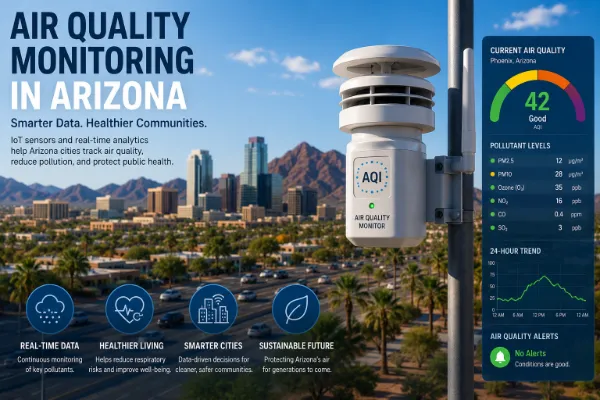
A construction site in Mesa, a school in Phoenix and a commercial warehouse in Goodyear can experience very different air quality conditions, even when they share the same regional air quality forecast. Disturbed desert soil, vehicle emissions, wildfire smoke, building ventilation and changing wind patterns create localized environmental conditions that regional monitoring stations cannot always capture at individual properties.
IoT air quality monitoring in Arizona addresses this information gap by connecting environmental sensors, wireless communication networks and data analytics platforms. These systems allow businesses, municipalities and facility managers to investigate pollution patterns, identify emerging environmental problems and evaluate the effectiveness of operational controls.
However, deploying air quality sensors in Arizona requires more than installing connected devices. Extreme temperatures, airborne dust, monsoon humidity, sensor accuracy and regulatory requirements all influence whether the resulting measurements are reliable enough to support decisions.
Arizona's environmental conditions create several distinct air pollution challenges. Ground-level ozone is an important concern in metropolitan areas, while disturbed soil, unpaved surfaces, agricultural operations and construction activities can contribute to particulate pollution. Wildfire smoke introduces another variable that can affect communities far from the original fire.
These pollutants behave differently and require different monitoring strategies. A device designed to measure fine particles from wildfire smoke may not accurately characterize coarse construction dust. Similarly, a carbon dioxide sensor installed inside an office cannot determine outdoor ozone concentrations.
| Environmental condition |
Relevant measurement |
Arizona monitoring application |
| Disturbed desert soil |
PM10, wind speed and direction |
Construction sites, industrial yards and unpaved roads |
| Wildfire smoke |
PM2.5 |
Schools, healthcare facilities and commercial buildings |
| Urban photochemical pollution |
Ground-level ozone |
Metropolitan air quality monitoring |
| Vehicle and combustion emissions |
NO2, CO and particulate matter |
Transportation corridors and loading areas |
| Indoor ventilation conditions |
CO2, temperature and humidity |
Classrooms, offices and occupied facilities |
| Industrial chemical emissions |
Pollutant-specific gas measurements |
Manufacturing and industrial processes |
Understanding these differences is the starting point for selecting an air quality monitoring system. Purchasing a multipurpose sensor without defining the pollutant, measurement objective and intended response can produce large amounts of data with limited operational value.
Arizona already has an established network of professional air quality monitoring stations operated by state and local environmental agencies.
The Arizona Department of Environmental Quality (ADEQ) conducts ambient air monitoring and uses atmospheric observations, forecasting and environmental research to assess pollution conditions throughout the state.
In Maricopa County, the air monitoring division provides enhanced monitoring data, including five-minute updates for PM10 and PM2.5 and hourly updates for other criteria pollutants. This information is particularly useful when environmental conditions are changing quickly.
The Maricopa County air quality monitoring platform also provides regional air quality information and dust-related notifications.
Southern Arizona has its own established monitoring infrastructure. The Pima County Department of Environmental Quality has conducted air monitoring in the Tucson area since the 1960s.
Regulatory monitoring stations are designed around established measurement methods and quality assurance requirements. Connected low-cost sensors serve a different purpose: they can increase the number of observation points within a defined area.
A municipality might investigate conditions near a school, a road corridor or a construction project using supplemental sensors while continuing to rely on agency monitoring for official regional air quality information.
The objective is not to replace government monitoring infrastructure. It is to supplement it with measurements that answer specific local questions.
An IoT air quality monitoring system combines environmental measurement hardware with communication infrastructure and software. Its effectiveness depends on the quality of every stage between the physical measurement and the final operational decision.
Sensor nodes measure selected pollutants and environmental conditions. Depending on the application, these devices may contain optical particle sensors, electrochemical gas sensors, carbon dioxide sensors and meteorological instruments.
Each sensor must be selected for its intended concentration range, operating environment and measurement limitations. A sensor suitable for indoor building monitoring may not withstand prolonged outdoor exposure in the Sonoran Desert.
Embedded processors can perform initial data checks, attach timestamps and identify readings that fall outside the device's operating range. Local storage can retain measurements during temporary network outages.
Using edge computing in Arizona is particularly relevant for remote environmental monitoring sites where continuous cloud connectivity cannot be guaranteed.
Sensor readings are transmitted through Wi-Fi, cellular networks, LoRaWAN or other suitable communication technologies.
Network selection depends on geographic coverage, reporting frequency, power consumption, available infrastructure and the volume of information being transmitted.
A monitoring platform receives measurements, maintains historical records and displays environmental trends. More advanced systems can combine pollutant readings with meteorological data, equipment operating conditions and maintenance records.
Validated measurements can trigger maintenance tickets, environmental investigations, dust-control inspections or building management notifications. Critical actions should remain subject to appropriate verification and human oversight.
For municipalities, these workflows can complement existing environmental and emergency notification systems without replacing official public health warning procedures.
No single sensor accurately measures every airborne pollutant. Effective environmental monitoring begins with matching the measurement technology to the pollution source and the intended application.
| Sensor technology |
Measurement |
Application |
Important limitation |
| Optical particle sensor |
Estimated PM2.5 and PM10 |
Smoke and particulate trend monitoring |
Particle composition, size and humidity can affect accuracy |
| Electrochemical gas sensor |
Selected gases, including CO, NO2 or ozone |
Outdoor and industrial monitoring |
Cross-sensitivity and sensor drift |
| NDIR sensor |
Carbon dioxide |
Indoor ventilation assessment |
Does not measure overall indoor air quality |
| Metal oxide gas sensor |
General VOC trends |
Indoor environmental monitoring |
Limited ability to identify individual compounds |
| Anemometer and wind vane |
Wind speed and direction |
Dust and pollutant dispersion investigation |
Results depend on placement and surrounding obstructions |
| Temperature and humidity sensor |
Environmental conditions |
Measurement interpretation and device diagnostics |
Requires appropriate shielding outdoors |
The EPA's Air Sensor Guidebook provides guidance for evaluating air sensors, developing monitoring projects and interpreting measurements.
Optical particulate sensors estimate particle concentrations by measuring scattered light. Their performance depends partly on the physical characteristics of airborne particles.
Desert dust can contain larger and differently shaped particles than those found in combustion-related pollution. Consequently, a sensor that performs acceptably during a smoke event may provide less reliable estimates during a dust event.
For construction monitoring, mining operations and industrial yards, buyers should review independent performance evaluations covering coarse particles rather than relying only on manufacturer specifications.
Air quality platforms frequently display pollutant concentrations and Air Quality Index values together. These measurements are related, but they are not interchangeable.
Particulate concentrations are commonly expressed in micrograms per cubic meter, while ozone and other gaseous pollutants may be reported in parts per billion or parts per million. The Air Quality Index converts applicable pollutant concentrations into a standardized scale intended to communicate health-related air pollution conditions.
| AQI range |
Air quality category |
| 0–50 |
Good |
| 51–100 |
Moderate |
| 101–150 |
Unhealthy for sensitive groups |
| 151–200 |
Unhealthy |
| 201–300 |
Very unhealthy |
| 301–500 |
Hazardous |
Calculating an AQI value requires the appropriate pollutant-specific concentration breakpoints and averaging methods. A single instantaneous reading from an unvalidated sensor should not automatically be presented as an official AQI value.
AirNow uses a method called the NowCast to communicate current air quality conditions while accounting for changing pollution levels. Its AQI interpretation guidance explains how current and daily air quality information should be used.
Organizations developing IoT dashboards should distinguish clearly between raw measurements, corrected concentrations, operational alerts and official public health information.
Consider a hypothetical construction project in the East Valley where grading, excavation and vehicle movement take place near occupied properties.
A single particulate sensor mounted beside heavy equipment would provide limited information about whether airborne dust is moving beyond the project boundary.
A more informative monitoring arrangement could include:
- An observation point positioned to assess incoming background conditions.
- Additional monitoring points near relevant project boundaries.
- Wind speed and direction measurements.
- Timestamped records of excavation and grading activities.
- Documentation of water application and other dust-control measures.
Comparing these measurements can help environmental managers investigate whether elevated particulate concentrations coincide with site activity, changing winds or broader regional dust events.
This approach can also complement existing IoT construction site monitoring systems, allowing environmental observations to be reviewed alongside equipment activity and project operations.
Construction operators should understand the requirements of Maricopa County Rule 310, which addresses fugitive dust from applicable dust-generating operations.
Connected particulate sensors can support operational awareness and environmental documentation, but their installation does not automatically demonstrate regulatory compliance. Applicable permits, control measures, inspections and approved measurement procedures remain necessary.
Arizona commercial buildings face an operational trade-off between maintaining suitable indoor environmental conditions and managing substantial cooling requirements. Introducing outdoor air supports ventilation, but outdoor pollution conditions and extreme temperatures can complicate building operations.
An indoor air quality monitoring system becomes more useful when its measurements are evaluated alongside HVAC operating data.
| Observed condition |
Additional information to investigate |
Possible operational response |
| Increasing indoor CO2 during occupancy |
Occupancy, outdoor CO2 and ventilation operation |
Investigate ventilation delivery and scheduling |
| Indoor PM2.5 increases during outdoor smoke events |
Outdoor PM2.5, filter condition and outdoor air intake |
Review filtration and building smoke-response procedures |
| Persistent particulate readings near an entrance |
Door activity, outdoor dust and nearby sources |
Investigate infiltration and local pollution sources |
| Environmental readings change when HVAC equipment starts |
Airflow, equipment schedules and sensor placement |
Check equipment operation and measurement reliability |
Integrating these observations with IoT HVAC monitoring can help facility teams investigate problems that would otherwise appear as isolated environmental readings.
Carbon dioxide is particularly useful when evaluating ventilation in occupied spaces. However, a normal CO2 reading does not establish that a building is free from particulate matter, chemical pollutants or other indoor environmental hazards.
For older commercial properties, indoor air monitoring can also form part of a broader smart building retrofit in Phoenix, where existing HVAC equipment and newer connected sensors must operate together.
Wildfire smoke can affect Arizona communities without an active fire being located nearby. Fine particulate matter can travel across regions and infiltrate buildings through ventilation systems, entrances and openings.
Monitoring both indoor and outdoor PM2.5 provides more useful information than relying on indoor measurements alone. Comparing the two can help facility teams investigate smoke infiltration and evaluate whether indoor concentrations change after filtration or building operation adjustments.
Schools, healthcare facilities and senior living properties may have particularly important reasons to understand these conditions because their occupants can include people more vulnerable to air pollution.
During a smoke event, monitoring systems should support established building response procedures and official public health recommendations. They should not automatically override minimum ventilation requirements, fire safety controls or healthcare ventilation standards.
The AirNow Fire and Smoke Map provides regional smoke-related air quality information by combining several sources, including monitoring stations and supplemental air sensor measurements.
Environmental monitoring equipment must survive the same conditions it is intended to measure. In Arizona, hardware reliability and measurement reliability are closely connected.
| Environmental challenge |
Potential monitoring problem |
Design consideration |
| Extreme summer temperatures |
Electronic failure or measurement drift |
Verify component operating temperature limits |
| Direct solar exposure |
Excessive enclosure temperatures |
Use appropriate shading and radiation protection |
| Airborne desert dust |
Blocked inlets and contaminated components |
Provide accessible inspection and maintenance points |
| Monsoon humidity |
Changes in optical particle measurements |
Record humidity and validate correction methods |
| Rapid dust events |
Sensor saturation or missing peak concentrations |
Evaluate measurement range and reporting intervals |
| Remote installation sites |
Communication interruptions |
Include local storage and tested network coverage |
| Storm exposure |
Water ingress and physical damage |
Use suitable enclosures, mounts and sampling inlet designs |
Temperature monitoring deserves particular attention. The internal temperature of a sensor enclosure exposed to direct sunlight can differ substantially from the surrounding ambient air.
This makes thermal design, shading and device diagnostics important parts of environmental monitoring projects. Similar engineering principles apply to IoT extreme heat monitoring systems deployed across Arizona.
Wireless connectivity should be selected according to the measurement and maintenance requirements of the project, rather than the advertised range of a communication technology.
| Connectivity |
Suitable application |
Planning consideration |
| Wi-Fi |
Indoor monitoring and connected buildings |
Network coverage, security and IT management |
| LoRaWAN |
Distributed outdoor sensor networks |
Gateway placement, payload limitations and reporting frequency |
| LTE-M or NB-IoT |
Remote and geographically separated sensors |
Carrier coverage, power consumption and service availability |
| Ethernet |
Permanent industrial and commercial installations |
Cabling, installation access and network segmentation |
For municipalities deploying multiple environmental monitoring nodes, LoRaWAN networks in Arizona may be suitable for transmitting compact measurements at defined intervals.
Applications requiring larger data transfers, frequent communication or geographically independent devices may benefit from alternative connectivity arrangements.
Monitoring platforms should also incorporate device authentication, encrypted communication where supported, controlled administrative access and secure software updates. These requirements are part of effective IoT security management, particularly when environmental devices connect to municipal or building infrastructure.
Localized environmental monitoring is already an established area of investigation within Arizona. ADEQ publishes reports covering community-specific ambient air quality monitoring projects.
Its published community monitoring project directory includes locations such as Beardsley Pit and Lehi Crossing in Maricopa County, Valle Vista in Mohave County, Rio Rico in Santa Cruz County, and Bear Mountain and Cottonwood in Yavapai County.
These projects demonstrate the importance of investigating environmental conditions at geographically specific locations rather than relying exclusively on statewide averages.
Another example comes from Pima County. In July 2023, the county's environmental quality department and the University of Arizona's Mel and Enid Zuckerman College of Public Health received EPA grant funding to expand localized air monitoring information at schools in Pima County.
For future Arizona smart city projects, these initiatives illustrate why monitoring locations, community concerns and measurement objectives should influence network design.
They do not imply that every listed project uses commercial IoT sensors or that a particular monitoring technology has been endorsed by the participating agencies.
Collecting thousands of readings does not establish measurement accuracy. Before using sensor data to make consequential operational decisions, organizations need to understand how the devices perform under actual deployment conditions.
Collocation involves operating an air sensor near a suitable reference instrument over a defined evaluation period. Comparing the resulting measurements can help identify systematic bias, changes in response and environmental influences.
EPA provides specific air sensor collocation guidance for organizations planning these evaluations.
Validation should not end when equipment is installed. Sensor contamination, component aging and seasonal environmental changes can affect subsequent measurements.
A monitoring platform should record device maintenance, communication failures, measurement errors and any correction methods applied to the data.
The success of an air monitoring project should be evaluated against its original purpose.
For a construction project, this may mean determining whether particulate patterns coincide with grading operations. For a school, it may involve evaluating ventilation trends during occupied hours. For an industrial property, it may involve identifying areas requiring professional environmental investigation.
Measurement completeness, device availability, agreement with suitable reference data and documented operational responses are more useful indicators of project performance than the number of sensors installed.
Before purchasing equipment, municipalities and businesses should establish a monitoring plan covering the pollutant of interest, required measurement quality, intended reporting interval, operating environment and responsibilities for responding to the data.
Start with a limited pilot deployment that represents the conditions the system will encounter. Evaluate measurement performance and maintenance requirements before expanding across additional properties or neighborhoods.
Building managers should also determine how environmental information will integrate with existing building automation software. Construction operators should establish who reviews alerts and how those alerts relate to required dust-control procedures.
The most valuable IoT air quality monitoring system is not necessarily the one with the largest network or the most sophisticated dashboard. It is the system that produces sufficiently reliable environmental information to answer a clearly defined local question.
In Arizona, achieving that objective requires careful sensor selection, appropriate placement, desert-ready engineering, validated measurements and a documented response process.
Frequently asked questions
IoT air quality monitoring uses connected environmental sensors to measure selected airborne pollutants and transmit readings to a monitoring platform. These systems can support environmental investigations, building operations, dust management and localized pollution monitoring.
PM10, PM2.5 and ground-level ozone are important outdoor air pollution measurements in Arizona. Depending on the location and pollution sources, monitoring projects may also measure nitrogen dioxide, carbon monoxide or other specific pollutants. Indoor monitoring often includes carbon dioxide, temperature and humidity.
Accuracy varies according to sensor technology, pollutant concentration, environmental conditions, maintenance and device design. Comparing sensors with appropriate reference instruments helps establish their suitability for a specific monitoring application.
Yes. Particulate sensors combined with wind measurements and construction activity records can support dust investigations and operational awareness. However, low-cost sensor measurements do not automatically establish compliance with applicable dust-control regulations.
PM2.5 refers to airborne particles with aerodynamic diameters generally measuring 2.5 micrometers or smaller. PM10 includes particles generally measuring 10 micrometers or smaller, including the finer PM2.5 fraction. Wildfire smoke often contains substantial fine particulate matter, while disturbed soil can contribute larger particles.
Yes. High temperatures can influence electronic components, measurement accuracy and long-term device reliability. Outdoor monitoring equipment should be evaluated for its operating temperature range, enclosure design, solar exposure and maintenance requirements.
Yes. Compatible environmental sensors can integrate with building automation and HVAC monitoring platforms to provide information about ventilation, particulate trends and indoor conditions. Automated responses must respect applicable ventilation, equipment and building safety requirements.
Generally, supplemental low-cost IoT sensors are not substitutes for regulatory-grade monitoring stations. Their primary value is expanding localized observations and supporting specific investigations. Official compliance assessments require appropriate approved methods and quality assurance procedures.
Related articles

 Public Safety