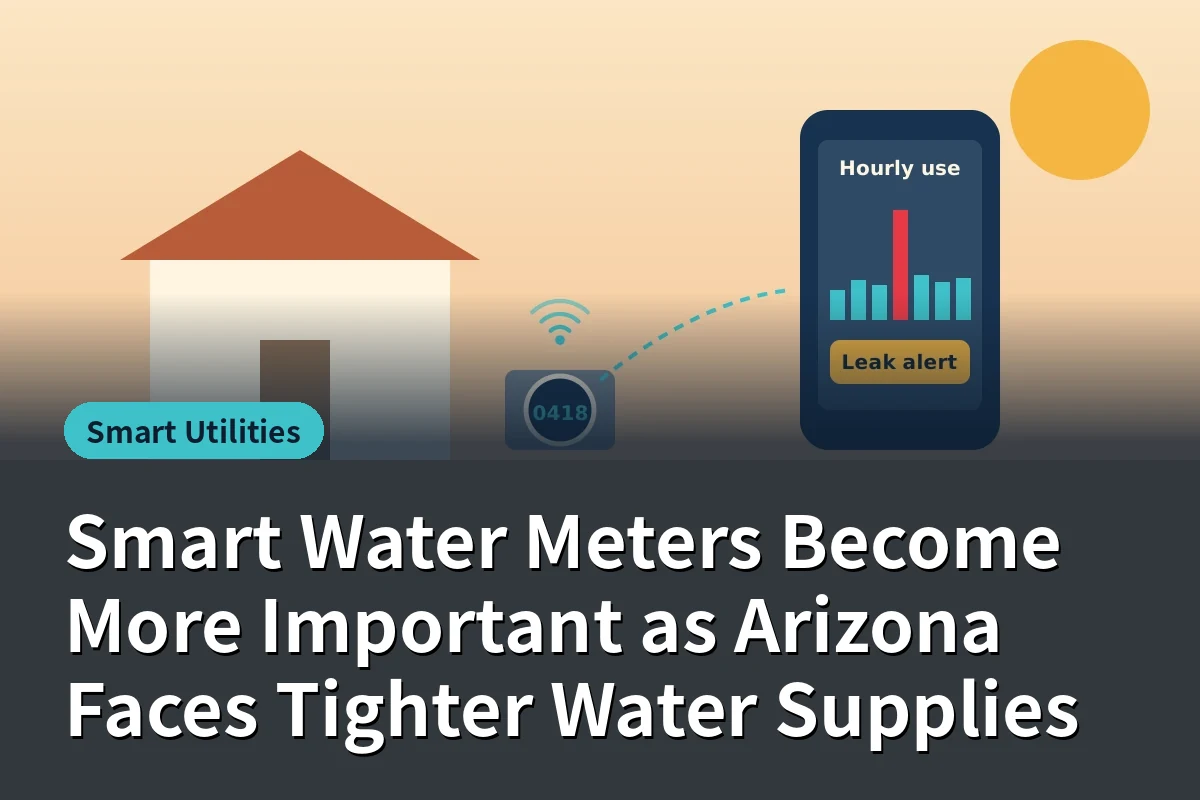
A homeowner in Scottsdale notices that their property consumes eight gallons of water every hour, including overnight when nobody is using the plumbing. The monthly water bill has not arrived, there is no visible flooding, and the irrigation system appears to be functioning normally.
If that consumption continues for 30 days, approximately 5,760 gallons of water will pass through the meter. Whether the cause is a running toilet, a leaking irrigation valve or another plumbing problem, the financial and environmental consequences accumulate with every hour.
This is where smart water meters offer a practical advantage over conventional monthly meter readings. Instead of discovering abnormal consumption weeks later, customers with access to interval water usage data can investigate unusual patterns much sooner.
However, not every Arizona water customer has access to the same technology. Some utilities provide hourly consumption records and automated leak alerts, while others are still upgrading meters, communications infrastructure and customer information systems.
Understanding what a smart water meter actually measures, how frequently its data becomes available and what different consumption patterns mean can help Arizona homeowners, businesses and property managers make better water management decisions.
One of the most misunderstood aspects of smart water metering is the difference between installing a connected meter and making its information available to customers.
A modern water meter may record consumption electronically, but several additional systems must operate correctly before that information appears in a customer portal.
The meter must collect readings, communicate with the utility's network, associate the information with the correct account and transfer validated data into the appropriate customer-facing software.
Each of these processes can have a different update frequency.
A meter may record consumption at hourly intervals while transmitting its accumulated readings less frequently. The customer portal may then require additional processing before displaying those readings.
Hourly consumption data should therefore not automatically be interpreted as live water flow monitoring.
| Metering Technology |
How Readings Are Collected |
Typical Customer Visibility |
| Traditional mechanical meter |
Physical readings collected by utility personnel |
Usually billing-period consumption |
| Automatic Meter Reading (AMR) |
Electronic readings collected remotely or through mobile reading equipment |
Depends on the collection schedule |
| Advanced Metering Infrastructure (AMI) |
Connected meters communicate through an established utility network |
May provide hourly or other interval consumption records |
| Private connected water monitor |
Customer-owned equipment observes water flow or related conditions |
Potentially near-real-time monitoring, depending on the product |
AMI can support substantially more detailed consumption analysis than conventional monthly readings. Nevertheless, the actual customer experience depends on the utility's network coverage, software capabilities and available account features.
For a deeper explanation of utility network design, metering communications and municipal leak analytics, see our guide to advanced water metering infrastructure in Arizona.
Arizona does not operate a single statewide water metering system. Municipal utilities, private water companies and other water providers establish their own infrastructure programs and customer services.
Even neighboring communities may provide different levels of access to water consumption information.
Scottsdale provides customers with water usage information through its WaterSmart service. Available features include consumption graphs, downloadable records, conservation recommendations and configurable notifications.
According to the city's published information, approximately 67 percent of its water customers had access to hourly consumption data as of December 2025.
Scottsdale expects its wider AMI infrastructure expansion to continue through 2030.
This means that customers with online utility accounts may not necessarily have hourly information available at their service address.
Residents and businesses can check their account capabilities and infrastructure availability through the official Scottsdale WaterSmart program.
Mesa began a multi-utility advanced metering infrastructure project in December 2021. Unlike a water-only meter exchange, the initiative includes municipal water, electricity and natural gas services.
The city's published project information reports more than 253,000 utility meter installations across these services, with completion of the combined project scheduled for December 2026.
That installation figure represents all participating utility meter types, not 253,000 water meters alone.
Mesa also documents its meter testing and billing validation procedures. These processes are important because remotely transmitting a reading does not independently guarantee that the resulting customer bill is correct.
Customers can find installation information, meter reading instructions and account updates on the City of Mesa Smart Meters project page.
Tucson Water completed an initial pilot involving approximately 100 smart water meters to evaluate the technology across different customer types.
The utility subsequently scheduled a larger rollout beginning in spring 2026, covering approximately 45,000 meters associated with non-residential accounts and other designated customer categories.
These include commercial and industrial properties, reclaimed water services, construction accounts and city-owned facilities.
Tucson Water identifies early 2027 as the planned launch period for its customer AMI portal.
Customers should distinguish between the published deployment schedule and confirmation that a particular property has received its upgrade.
The official Tucson Water AMI project information provides installation guidance and program updates.
| Arizona Water Provider |
Documented Program |
What Customers Should Verify |
| Scottsdale Water |
WaterSmart and ongoing AMI expansion |
Hourly data and leak alert eligibility at the service address |
| City of Mesa |
Multi-utility smart meter modernization |
Meter exchange status and available online account features |
| Tucson Water |
Phased AMI deployment |
Installation schedule and customer portal availability |
Program information reviewed in November 2026. Installation figures and future milestones reflect published municipal information and may change.
People frequently associate serious water leaks with visible flooding or substantial plumbing damage. However, a relatively small continuous flow can result in considerable water consumption when it remains undetected for several weeks.
A smart meter's greatest value may be identifying these persistent patterns rather than detecting a dramatic increase in instantaneous water flow.
The estimated volume of continuous water loss can be calculated by multiplying the hourly flow by the number of hours the condition persists.
Estimated water loss = Continuous flow in gallons per hour × Duration in hours.
| Continuous Water Flow |
Daily Consumption |
30-Day Consumption |
Annual Consumption |
| 1 gallon per hour |
24 gallons |
720 gallons |
8,760 gallons |
| 2 gallons per hour |
48 gallons |
1,440 gallons |
17,520 gallons |
| 5 gallons per hour |
120 gallons |
3,600 gallons |
43,800 gallons |
| 8 gallons per hour |
192 gallons |
5,760 gallons |
70,080 gallons |
| 10 gallons per hour |
240 gallons |
7,200 gallons |
87,600 gallons |
| 20 gallons per hour |
480 gallons |
14,400 gallons |
175,200 gallons |
Calculated values assume uninterrupted flow for 24 hours per day, a 30-day month and a 365-day year. Actual water loss depends on the duration and behavior of the leak.
These calculations demonstrate why relatively small plumbing or irrigation problems deserve investigation even when they do not immediately create visible property damage.
The financial impact depends on the applicable water tariff, consumption tiers, wastewater billing rules and other utility charges.
Hourly water consumption records are most useful when interpreted alongside the activities occurring at the property.
A single high-consumption interval does not necessarily establish that something is wrong. Laundry, irrigation, pool maintenance and other legitimate activities can produce temporary increases in water usage.
Persistent consumption during periods when little or no water should be used generally deserves closer examination.
The following hypothetical example illustrates two different overnight water consumption patterns at a residential property.
| Hourly Interval |
Example A: Scheduled Use |
Example B: Persistent Consumption |
| 12:00 a.m. to 1:00 a.m. |
0 gallons |
8 gallons |
| 1:00 a.m. to 2:00 a.m. |
0 gallons |
8 gallons |
| 2:00 a.m. to 3:00 a.m. |
80 gallons |
8 gallons |
| 3:00 a.m. to 4:00 a.m. |
60 gallons |
8 gallons |
| 4:00 a.m. to 5:00 a.m. |
0 gallons |
8 gallons |
| 5:00 a.m. to 6:00 a.m. |
0 gallons |
8 gallons |
| Total consumption |
140 gallons |
48 gallons |
Example A consumes more water overall, but the pattern could be consistent with an irrigation system operating according to its schedule.
Example B consumes less water during the same period but demonstrates persistent hourly consumption that may warrant investigation.
Neither pattern independently establishes the cause. Pool autofill systems, water treatment equipment, irrigation controllers and other devices can operate automatically when occupants are asleep.
The important distinction is between expected consumption and unexplained consumption, rather than simply comparing high and low readings.
Water usage graphs can help narrow down possible explanations for abnormal consumption. They cannot independently identify the exact location or mechanical cause of every plumbing problem.
| Observed Meter Pattern |
Possible Explanation |
What to Investigate |
| Persistent low-volume consumption |
Running toilet, dripping fixture or small plumbing leak |
Fixtures and equipment that may operate continuously |
| Recurring high overnight consumption |
Scheduled irrigation or other automatic equipment |
Irrigation programs and equipment operating schedules |
| Sudden sustained increase |
Potential plumbing or irrigation failure |
Prompt professional investigation |
| Repeated intermittent consumption |
Automatic refill cycles or intermittent equipment operation |
Toilets, pool autofill and water treatment equipment |
| Higher daytime consumption only |
Increased occupancy or business activity |
Changes in normal property operations |
| Unexpected consumption at a vacant property |
Automatic systems, unauthorized usage or a possible leak |
Scheduled equipment and property condition |
| Missing consumption records |
Potential communications or data processing interruption |
Portal status and utility data availability |
Missing data should not be treated as proof that no water was consumed. A communications interruption can delay the appearance of readings even when the physical meter continues measuring water usage.
Customers who require more immediate property protection can consider dedicated IoT water leak detection systems alongside their utility's metering services.
Automated leak alerts generally depend on predefined analytical rules. These rules may consider consumption volume, persistence, time of day and other characteristics of the meter data.
A utility may require unusual consumption to continue for a specified period before generating a notification. This helps distinguish persistent consumption from normal temporary water use.
The trade-off is that water may continue flowing while the system collects enough information to identify an abnormal pattern.
For illustration, a continuous flow of eight gallons per hour would consume 576 gallons over 72 hours.
The existence of an alert therefore does not mean that water loss has been prevented. It means the available information has met the conditions used to generate a notification.
Other factors can influence when a customer receives an alert, including:
- The meter's consumption recording interval.
- The frequency of communications with the utility network.
- The utility's analytical and notification rules.
- The customer's account eligibility and notification preferences.
- The availability of accurate contact information.
- Temporary communications or software interruptions.
Customers should check the specific conditions of their utility's notification service rather than assuming every unusual flow will produce an immediate warning.
For vacant homes, commercial properties containing valuable inventory and buildings where water damage could create major operational disruptions, additional property-level monitoring may be appropriate.
An unusually expensive water bill does not always mean that a recently installed smart meter is defective.
The increase may result from additional consumption, seasonal irrigation, a longer billing period, revised utility charges, an undetected leak or a billing configuration issue.
A useful investigation begins by separating water consumption from the total financial amount charged.
Suppose a property receives the following two hypothetical water bills.
| Billing Period |
Days |
Total Water Consumption |
Average Daily Consumption |
| Previous bill |
28 |
8,400 gallons |
300 gallons per day |
| Current bill |
35 |
10,500 gallons |
300 gallons per day |
Total consumption increased by 25 percent, but average daily water use remained unchanged.
In this example, the higher total volume can be explained by the longer billing period rather than an increase in daily consumption.
Water providers do not necessarily display consumption using identical measurement units.
Some records show gallons, while others use cubic feet or hundreds of cubic feet.
One cubic foot of water is approximately 7.48 gallons. One hundred cubic feet, commonly abbreviated as CCF, is approximately 748 gallons.
Customers comparing physical meter readings, billing records and online consumption information should confirm that the measurements use compatible units.
A water bill may include fixed service charges, volumetric water charges, wastewater charges and other applicable fees.
Some utilities use tiered water rates that increase the marginal cost of consumption as customers enter higher usage categories.
Consequently, an increase in the total bill may be proportionally greater than the increase in water consumption.
Customers should review their actual utility tariff before estimating how much money a leak has cost.
The U.S. Environmental Protection Agency's WaterSense home maintenance guidance recommends checking the water meter before and after a two-hour period during which no water is intentionally used.
If the reading changes during that period, unexplained water consumption may be occurring.
Before conducting the test, account for automatic irrigation, pool filling, ice makers and other appliances that may use water without direct occupant activity.
Follow your utility's instructions for reading its meter safely. Do not remove protected utility equipment, enter hazardous meter vaults or operate utility-owned valves without authorization.
If unexplained consumption continues, contact the water provider or a qualified plumbing professional for further investigation.
Outdoor water use can create substantial seasonal changes in residential and commercial consumption throughout Arizona.
Landscaping requirements, weather conditions, plant selection, irrigation schedules and equipment condition influence how much water a property uses outdoors.
Comparing July water consumption directly with January consumption may therefore produce misleading conclusions.
A more useful evaluation compares equivalent seasons, similar irrigation schedules and representative property conditions.
Consider a commercial landscape using irrigation three times per week. If recorded consumption increases substantially while its programmed watering duration remains unchanged, the discrepancy may justify investigation.
Potential explanations include damaged irrigation equipment, changes in water pressure, altered controller settings or other changes in the property's outdoor water requirements.
Where a property has a separate irrigation meter, distinguishing indoor consumption from outdoor consumption becomes easier.
Properties using a single utility meter may benefit from compatible irrigation monitoring or separate private submeters when more detailed information is necessary.
These systems complement the broader connected water management technologies used across Arizona, but their primary purpose is understanding how water is consumed at an individual property.
Hotels, apartment communities, restaurants, healthcare facilities and industrial properties have fundamentally different water consumption patterns.
Comparing their total monthly water usage provides limited information unless the figures are evaluated against an appropriate operational measure.
A hotel may compare consumption with occupied room nights, while a restaurant may evaluate usage relative to meals served. An apartment community may review consumption against occupied dwelling units.
| Property Type |
Useful Water Performance Indicator |
Additional Monitoring Priority |
| Hotel or resort |
Gallons per occupied room night |
Laundry, pools and landscape irrigation |
| Apartment community |
Gallons per occupied dwelling unit |
Shared plumbing and common-area consumption |
| Restaurant |
Gallons per meal or customer served |
Kitchen equipment and continuous overnight flow |
| Office building |
Gallons per occupied person-day |
Restrooms, irrigation and cooling systems |
| Manufacturing facility |
Gallons per unit of production |
Process water and equipment consumption |
| Shopping center |
Consumption by tenant or operational area |
Tenant submeters and landscape systems |
These are suggested analytical indicators rather than universal industry performance benchmarks.
The objective is to distinguish changes in water efficiency from changes in business activity.
A hotel whose occupancy increases substantially may consume more water overall while maintaining or improving its water efficiency per occupied room.
Properties with multiple water-consuming systems can compare their total utility meter readings with measurements from selected submeters.
Consider a hypothetical commercial property recording 120,000 gallons of water consumption in one month.
| Measured Water Use |
Monthly Consumption |
| Main utility meter |
120,000 gallons |
| Tenant plumbing submeters |
62,000 gallons |
| Landscape irrigation |
28,000 gallons |
| Cooling system makeup water |
18,000 gallons |
| Total identified consumption |
108,000 gallons |
| Unallocated consumption |
12,000 gallons |
The remaining 12,000 gallons represent 10 percent of the property's total recorded consumption.
This difference should not automatically be classified as leakage. Unmetered common areas, measurement uncertainty, differences between reading periods and other legitimate uses could contribute to the discrepancy.
A water balance provides an investigation starting point rather than a definitive diagnosis.
Smart water meters can improve the consistency and accessibility of consumption records by reducing dependence on manual reading processes.
However, the ability to transmit readings electronically is separate from the physical accuracy of the meter.
Several factors influence the quality of a recorded water measurement:
- The meter's measurement technology and flow range.
- Equipment condition and installation quality.
- The ability to register very low flow rates.
- Meter configuration and measurement units.
- Data processing and account assignment.
- Consistency between meter records and billing information.
Mesa's published metering project provides a useful example of why utilities incorporate equipment testing and data verification into infrastructure upgrades.
The city describes pre-installation accuracy testing, meter configuration checks and parallel manual readings during an initial period after installation.
These quality control procedures demonstrate that reliable billing requires more than simply replacing a mechanical meter with connected equipment.
A customer concerned about accuracy should request an explanation of the utility's meter testing and billing review process. The applicable procedures and any testing fees may vary between water providers.
Understanding the limitations of smart water metering is essential when deciding whether additional monitoring equipment is necessary.
A utility water meter generally observes consumption passing through a defined metering point. It does not automatically identify which fixture, pipe or appliance used that water.
It may also have limited ability to register certain very small flows, depending on the equipment's measurement specifications.
A customer-side meter cannot ordinarily measure water lost from utility distribution pipes upstream of that metering point.
Utility-side distribution leak detection requires additional approaches, which may include pressure monitoring, acoustic sensing, district-level water balances and other infrastructure assessment methods.
Our article on water utility leak detection and analytics in Arizona examines that separate infrastructure challenge.
Similarly, smart water meters do not necessarily provide automatic water shutoff capability. Where automatic isolation is required, the property may need a compatible, professionally installed monitoring and valve system.
Customers should therefore distinguish between consumption monitoring, leak detection, leak location and automated water isolation. These are related but different functions.
Smart water metering can help reduce the time between the beginning of an abnormal consumption event and its investigation.
Consider a hypothetical continuous leak consuming 10 gallons per hour.
If the problem remains undetected for 30 days, it consumes approximately 7,200 gallons. If the same problem is identified and repaired after three days, the recorded loss is approximately 720 gallons.
The difference is 6,480 gallons of potentially avoided water consumption.
| Illustrative Marginal Water Rate |
Potential Water Charge Reduction |
| $3 per 1,000 gallons |
$19.44 |
| $5 per 1,000 gallons |
$32.40 |
| $8 per 1,000 gallons |
$51.84 |
| $12 per 1,000 gallons |
$77.76 |
The rates are hypothetical and do not represent published prices from specific Arizona water providers. The calculations exclude fixed charges, wastewater charges, repairs and property damage.
The example illustrates an important distinction. A property's direct water charge savings may be relatively modest compared with the potential cost of prolonged moisture exposure, emergency plumbing repairs or damage to building materials.
Water conservation and property protection should consequently be considered together when evaluating additional monitoring investments.
The installation of a connected meter creates an opportunity to establish better water management habits.
Customers should first determine whether interval consumption information is available through their utility account. If the service offers notifications, review the available alert settings and ensure contact information is current.
Examining several weeks of normal water usage can help establish a reference for interpreting future changes. Pay particular attention to irrigation schedules, overnight consumption and automatic equipment operation.
Commercial property managers should also assign responsibility for reviewing abnormal consumption and coordinating maintenance responses. An alert has limited value when nobody is responsible for investigating it.
Where a repair is completed, subsequent consumption records can help establish whether the abnormal pattern has disappeared.
Smart water meters do not solve plumbing problems independently. Their value comes from reducing uncertainty about when water is being consumed and helping customers respond to unexplained usage before it continues unnecessarily.
For Arizona, where water conservation is closely connected to long-term infrastructure planning, the opportunity is not simply collecting more information. It is turning measurable consumption into earlier, better-informed decisions at individual properties.
Frequently asked questions
Smart water meters measure water consumption electronically or through compatible meter registers and communicate readings to utility information systems. Depending on the provider's infrastructure, customers may access detailed usage records, historical comparisons and automated notifications.
Not necessarily. Some utilities provide hourly consumption records, but those readings may be transmitted or processed later. Customers should confirm the actual update frequency and available account features with their water provider.
Automatic irrigation, pool autofill equipment, water treatment systems, running toilets or plumbing leaks may consume water when a property is unoccupied. Persistent unexplained consumption warrants investigation.
A smart water meter may identify unusual consumption passing through its measurement point, but it generally cannot establish the exact physical location of a leak. Additional inspection or specialized leak detection equipment may be required.
Most utility smart water meters primarily measure and communicate consumption. Automatic water shutoff requires compatible equipment, appropriate installation and supported control functionality. Customers should not assume their utility meter includes this capability.
Possible explanations include increased consumption, seasonal irrigation, different billing periods, revised rates, existing leaks or a billing issue. Compare average daily consumption, measurement units and applicable charges before requesting a meter accuracy investigation.
Not necessarily. These utilities have different metering deployment schedules and customer information systems. The availability of hourly readings depends on the service address, installed infrastructure and customer account features.
Related articles

 Smart Utilities