Two rooftop air-conditioning units serving the same Arizona shopping center may operate for nearly identical hours during spring. By July, one continues maintaining comfortable indoor temperatures while the other runs almost continuously without meeting its cooling setpoint.
Both units may appear operational on a conventional building management dashboard. Neither has necessarily generated an equipment failure alarm. Yet one is no longer delivering the cooling performance the property requires.
This is the operational problem that smart HVAC monitoring needs to solve in Arizona. Knowing whether equipment is running is not enough. Commercial property managers need to understand whether that equipment is delivering useful cooling under increasingly demanding environmental conditions.
The distinction matters in a state where prolonged heat can expose weaknesses that remain unnoticed throughout milder months. According to the Arizona State Climate Summary, Phoenix experienced 113 consecutive days with maximum temperatures reaching at least 100 degrees Fahrenheit in 2024, including 70 days reaching at least 110 degrees.
For commercial buildings, sustained heat creates an extended test of cooling capacity, equipment condition, maintenance practices and operational resilience. Connected HVAC monitoring provides a way to evaluate those factors before equipment performance deteriorates into a serious disruption.
Many commercial HVAC monitoring platforms begin with equipment status: whether a compressor is operating, a supply fan is running or a thermostat is requesting cooling.
Although this information is useful, it cannot independently establish whether the equipment is meeting the building's needs.
A rooftop unit can consume electricity, circulate air and operate throughout the afternoon while delivering insufficient cooling to the occupied space.
Several different conditions can produce this outcome:
- The building's cooling demand exceeds the available equipment capacity.
- Equipment performance has deteriorated since installation.
- Air distribution problems prevent conditioned air from reaching occupied areas.
- Control settings do not reflect the building's operating requirements.
- Outdoor air intake or ventilation controls are operating incorrectly.
- Recent changes in occupancy or internal equipment have increased cooling requirements.
These conditions require different responses. Replacing equipment will not necessarily resolve a building scheduling problem. Adjusting a thermostat will not restore cooling capacity lost through mechanical degradation.
Smart HVAC monitoring becomes valuable when it helps facility teams distinguish between these possibilities rather than treating every temperature complaint as an equipment failure.
Commercial air-conditioning equipment is selected according to anticipated building cooling loads and equipment performance under specified conditions.
However, a rooftop unit's nominal cooling capacity does not mean it delivers exactly that amount of cooling under every outdoor temperature, indoor humidity level or airflow condition.
As outdoor temperatures increase, the operating conditions experienced by air-cooled equipment change. Available cooling capacity and equipment efficiency may differ from their nominal ratings.
Property managers evaluating equipment performance should consult manufacturer performance data for the specific model and operating conditions rather than assuming that the capacity printed on the equipment label remains constant throughout the year.
This becomes particularly important when comparing older rooftop equipment with recently installed units.
Two nominally identical five-ton systems may have different actual performance because of equipment design, installation quality, maintenance condition and operating environment.
Monitoring should therefore establish whether each unit is meeting its assigned cooling requirements rather than simply comparing its nameplate capacity with another unit.
A commercial building may experience insufficient cooling even when its HVAC equipment is operating as designed.
New kitchen equipment, additional occupants, extended operating hours, changes to interior partitions or increased solar exposure can alter the building's cooling requirements.
Before classifying a rooftop unit as defective, facility teams should determine whether the building's current cooling load remains consistent with the assumptions used when the equipment was selected.
This distinction helps owners avoid replacing functional equipment when building design, air distribution or operational changes are responsible for the problem.
A monitoring platform becomes significantly more useful when it has an established record of normal equipment behavior.
Without that baseline, a facility manager may receive an alert indicating extended compressor runtime without knowing whether that behavior is unusual for the building.
An effective baseline should capture representative operating conditions during different outdoor temperatures, occupancy levels and business schedules.
For Arizona commercial properties, collecting information during spring can help establish a reference before sustained summer cooling demand arrives. Historical summer data, where available, provides additional context for evaluating performance during more demanding conditions.
| Baseline Measurement |
What It Establishes |
How It Supports Future Decisions |
| Occupied zone temperature |
Normal indoor conditions during business hours |
Identifies deteriorating cooling performance |
| Cooling setpoint |
Intended indoor operating temperature |
Distinguishes unmet cooling demand from scheduled adjustments |
| Compressor runtime |
Typical equipment operation under comparable conditions |
Identifies unusual changes in operating duration |
| Equipment electricity consumption |
Normal electrical demand and energy usage |
Supports efficiency and maintenance analysis |
| Supply and return air conditions |
Reference cooling behavior at the equipment |
Supports investigation of performance deterioration |
| Outdoor temperature and humidity |
Environmental conditions affecting cooling requirements |
Enables meaningful seasonal comparisons |
| Occupancy and operating schedule |
Building usage during monitored periods |
Separates equipment changes from changes in demand |
Not every building needs sophisticated instrumentation on every HVAC component. The initial monitoring scope should reflect the property's equipment, operational risk and available maintenance resources.
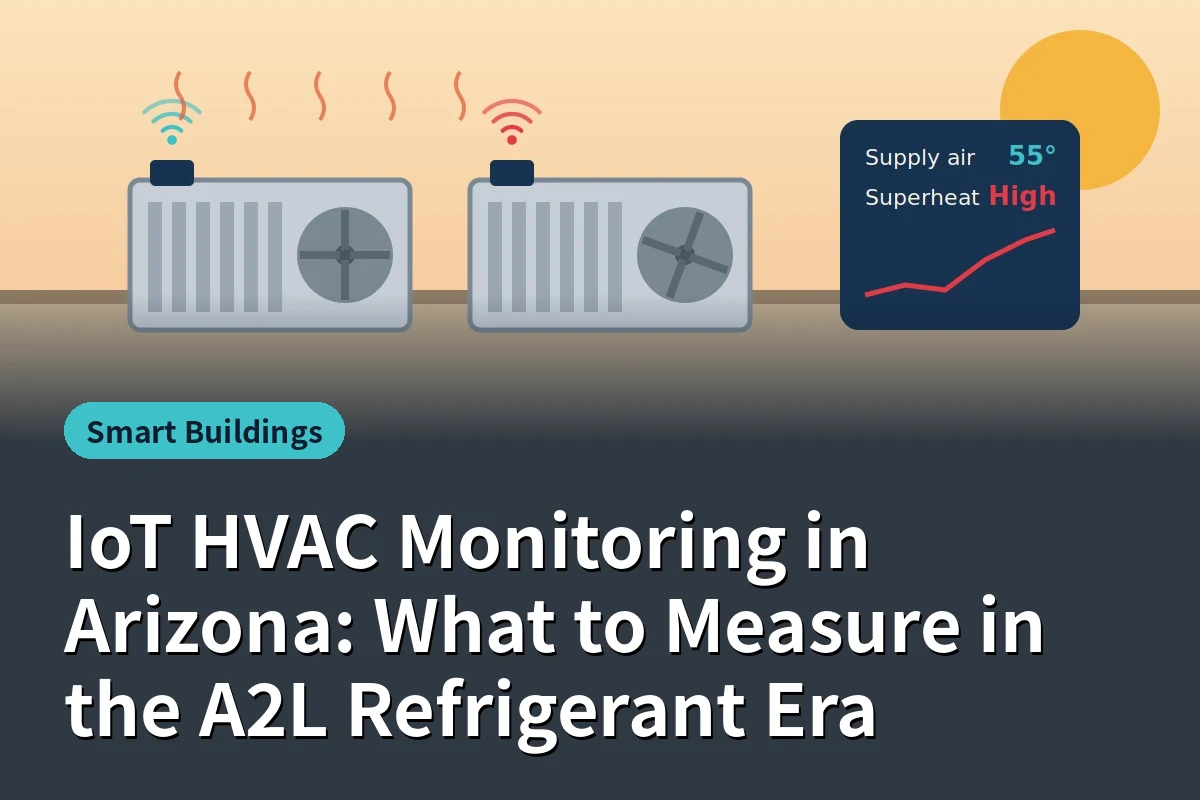
Our companion guide to IoT HVAC monitoring and the A2L refrigerant transition examines individual sensor measurements, refrigerant considerations and retrofit options in greater detail.
Equipment runtime is frequently used to evaluate HVAC performance. However, runtime alone does not explain whether occupants are receiving the cooling they require.
A more useful complementary measurement is the amount of occupied time during which indoor temperatures exceed an agreed cooling threshold.
For example, a property manager could establish a building-specific monitoring threshold of two degrees Fahrenheit above the occupied cooling setpoint. The threshold is an illustrative operational benchmark, not a universal comfort standard or legal temperature limit.
Each monitored interval exceeding that threshold can contribute to a cooling deficit measurement.
Consider three hypothetical rooftop units serving comparable occupied commercial spaces with a scheduled cooling setpoint of 75 degrees Fahrenheit.
| Equipment |
Occupied Monitoring Period |
Time Above 77°F |
Cooling Deficit Percentage |
| RTU-01 |
200 hours |
4 hours |
2% |
| RTU-02 |
200 hours |
18 hours |
9% |
| RTU-03 |
200 hours |
52 hours |
26% |
The figures are hypothetical and demonstrate a possible portfolio performance measurement. Actual thresholds should reflect building requirements and professional recommendations.
RTU-03 warrants investigation because the associated occupied space experiences substantially more time above the selected temperature threshold.
That does not establish that the rooftop unit itself is defective. Building cooling loads, thermostat placement, airflow distribution and equipment controls should also be evaluated.
Property managers can refine this approach by calculating cooling degree-hours, which account for both the duration and magnitude of temperature deviations.
A space remaining one degree above its target for four hours experiences a smaller cumulative temperature deviation than a space remaining five degrees above its target for the same duration.
These measurements provide a more meaningful view of cooling performance than simply reporting the number of HVAC alarms generated each month.
During exceptionally hot Arizona afternoons, a correctly functioning rooftop unit may operate for extended periods.
A monitoring system that generates an alarm whenever compressor runtime exceeds a fixed duration can create unnecessary service calls during normal high-demand conditions.
A stronger approach compares equipment operation with outdoor conditions, cooling demand and the indoor temperatures being achieved.
| Observed Condition |
Possible Interpretation |
Appropriate Next Step |
| Long runtime with stable indoor temperature |
Equipment may be responding normally to high cooling demand |
Compare with historical operation under similar conditions |
| Long runtime with rising indoor temperature |
Cooling demand may exceed available performance |
Investigate equipment condition and building cooling load |
| Increasing electricity use under comparable conditions |
Possible efficiency deterioration or changed operating conditions |
Review equipment and control performance |
| Repeated short operating cycles |
Possible control, sizing or equipment issue |
Request professional diagnostic assessment |
| Normal equipment operation but uneven zone temperatures |
Possible air distribution or building envelope issue |
Evaluate airflow and affected occupied spaces |
| Failure to recover after outdoor temperatures decline |
Possible persistent capacity, load or control problem |
Review operational trends and arrange inspection |
None of these observations independently identifies a mechanical fault. They provide evidence that can help qualified HVAC technicians investigate the underlying cause.
Combining several measurements reduces the risk of interpreting normal summer operation as equipment failure.
Fault detection and diagnostics, commonly abbreviated as FDD, uses building operational information to identify abnormal equipment or system behavior and help determine potential causes.
Unlike a basic thermostat alarm, an FDD platform may evaluate relationships between multiple measurements, equipment commands and expected operating behavior.
There is documented evidence that building analytics can support meaningful energy savings.
The U.S. Department of Energy's Smart Energy Analytics Campaign results covered 104 participating organizations, approximately 6,500 buildings and more than half a billion square feet of combined floor area.
Reported median annual energy savings were approximately 3 percent for energy information systems and 9 percent for fault detection and diagnostic tools.
These results are national research benchmarks. They are not guaranteed savings for individual Arizona properties, and they should not be interpreted as reductions in HVAC electricity consumption alone.
The findings are particularly relevant because they distinguish between collecting energy information and using more advanced analytics to identify actionable operational problems.
| Technology Approach |
Primary Capability |
Example |
| Remote HVAC monitoring |
Observes and reports operating conditions |
Notifies a manager when indoor temperature exceeds a threshold |
| Fault detection |
Identifies behavior inconsistent with expected operation |
Flags abnormal equipment operation during comparable cooling conditions |
| Fault diagnostics |
Helps identify potential explanations for abnormal behavior |
Suggests investigation of equipment, control or airflow problems |
| Predictive maintenance |
Estimates future deterioration or maintenance requirements |
Identifies a persistent performance trend requiring inspection |
| Automated optimization |
Adjusts supported equipment controls within defined limits |
Coordinates approved cooling schedules with building occupancy |
These capabilities may be available within the same software platform, but each requires different data, integration and validation.
A business purchasing remote monitoring should not automatically assume that it is also purchasing reliable failure prediction or automated optimization.
Lawrence Berkeley National Laboratory maintains a dedicated building fault detection and diagnostics research resource covering analytical approaches and HVAC operational datasets.
Commercial property owners often manage equipment installed at different times, manufactured by different companies and maintained by multiple service providers.
Portfolio-level monitoring offers an opportunity to compare performance and identify units requiring attention. However, comparisons need to account for differences between the spaces each unit serves.
A rooftop unit serving a restaurant should not automatically be compared with one serving a lightly occupied office. Commercial kitchens, ventilation requirements, operating hours and internal heat sources can create substantially different cooling loads.
Useful comparison groups might include units serving similar tenant types, equipment of comparable capacity or buildings with similar operational schedules.
Facility managers should evaluate each unit against both its own historical behavior and an appropriate equipment comparison group.
Consider a hypothetical Arizona commercial property portfolio operating 60 rooftop HVAC units.
After reviewing operational information during comparable summer conditions, the facility team identifies the following equipment categories.
| Equipment Category |
Units |
Observed Condition |
Management Priority |
| Normal performance |
38 |
Stable temperatures and expected operating behavior |
Continue routine maintenance |
| Efficiency concerns |
12 |
Increased energy use under comparable conditions |
Schedule operational review |
| Cooling performance concerns |
7 |
Repeated occupied temperature deviations |
Prioritize diagnostic inspection |
| Recurring operational failures |
3 |
Repeated interruptions and unresolved service issues |
Evaluate repair and replacement options |
Without performance monitoring, the owner might allocate maintenance resources uniformly across all 60 units or replace equipment primarily according to age.
With better operational information, maintenance and capital planning can focus on the equipment exhibiting the greatest verified performance concerns.
Monitoring does not remove the need for scheduled maintenance. It helps determine where additional investigation, accelerated maintenance or replacement evaluation may be justified.
Our broader article on predictive maintenance for Arizona commercial properties explores how similar asset management principles apply beyond HVAC equipment.
Arizona cooling strategies frequently depend on the relationship between daytime heat accumulation and the building's ability to recover during cooler periods.
When nighttime outdoor temperatures remain elevated, commercial buildings may have fewer opportunities to reduce accumulated heat without mechanical cooling.
Building construction, insulation, glazing, thermal mass, occupancy schedules and HVAC controls all influence the amount of cooling required when business operations resume.
A building entering the morning substantially warmer than its expected operating condition may experience prolonged cooling recovery, even when the equipment itself is functioning properly.
Facility managers can monitor morning recovery time by recording the interval between the beginning of scheduled cooling and achievement of the intended occupied conditions.
Comparisons should consider overnight temperatures, previous-day heat exposure and changes in building schedules.
Longer recovery times may indicate that schedules need professional review, that equipment performance has deteriorated or that the building is experiencing increased thermal loads.
The objective is not necessarily to operate cooling equipment earlier or for longer periods. It is to identify the cause of inadequate recovery and establish an operating strategy appropriate for the building.
Our analysis of Phoenix heat and smart building performance examines the broader implications of prolonged heat for commercial and residential infrastructure.
Improving HVAC performance and reducing electricity expenses are related but distinct objectives.
A property may need to maintain longer cooling operation to protect occupants or equipment even when doing so increases electricity consumption.
Conversely, a building may have substantial opportunities to reduce avoidable electricity use without compromising indoor conditions.
Commercial electricity tariffs can also contain different combinations of energy charges, demand charges and time-dependent pricing.
This means an HVAC optimization project should be evaluated against the property's actual utility tariff rather than a single assumed electricity rate.
Suppose monitoring identifies six commercial rooftop units operating unnecessarily for two hours after business closure on 250 days per year.
Assume each unit averages 3 kW of electrical demand during those periods.
6 units × 3 kW × 2 hours × 250 days = 9,000 kWh annually.
Using an illustrative marginal energy rate of $0.12 per kWh, eliminating this unnecessary operation could reduce annual energy charges by approximately $1,080.
This calculation excludes demand charges, taxes, equipment effects and any operational requirements that justify continued cooling or ventilation after business hours.
It is an example of measuring a specific operational opportunity rather than assuming that installing monitoring equipment automatically reduces energy expenses by a fixed percentage.
For more detailed approaches to commercial energy measurement and verification, see IoT building energy management in Arizona.
Businesses evaluating connected HVAC improvements should investigate available electricity provider programs before committing to an installation.
Salt River Project's published Business Solutions rebate information includes commercial HVAC categories such as advanced rooftop controls, energy management systems, variable-frequency drives and other eligible equipment improvements.
The existence of an HVAC rebate category does not establish that a specific monitoring installation qualifies.
Monitoring-only products, advanced equipment controls and complete HVAC replacement projects can be subject to different program requirements.
Property owners should confirm current eligibility, applicable equipment specifications, project approval requirements and available incentives directly with their electricity provider.
Program incentives should be included in financial projections only after the project meets the applicable requirements.
Commercial HVAC monitoring may provide financial value through several mechanisms, including reduced unnecessary equipment operation, earlier identification of maintenance concerns and better equipment replacement planning.
These benefits should be evaluated separately to avoid double-counting the same operational improvement.
The following example illustrates a hypothetical monitoring investment for a commercial property with 20 rooftop units.
| Financial Component |
Illustrative Value |
| Monitoring hardware and installation |
$12,000 |
| Software integration and commissioning |
$4,000 |
| Total initial investment |
$16,000 |
| Annual measured energy cost reduction |
$5,000 |
| Annual avoided emergency service expenditure |
$3,000 |
| Annual software and monitoring expenses |
$2,400 |
| Net annual financial benefit |
$5,600 |
| Illustrative simple payback |
Approximately 2.9 years |
All figures are hypothetical. They are not Arizona market quotations, independently measured project outcomes or guaranteed financial returns.
The example demonstrates why software fees, commissioning expenses and ongoing monitoring responsibilities must be considered alongside potential operational savings.
Avoided emergency service expenditure is particularly difficult to verify because it involves estimating events that might otherwise have occurred. Conservative financial evaluations should distinguish directly measured savings from estimated avoided costs.
Where uncertainty remains substantial, owners can evaluate multiple scenarios.
| Annual Gross Financial Benefit |
Annual Operating Cost |
Net Annual Benefit |
Simple Payback on $16,000 |
| $4,000 |
$2,400 |
$1,600 |
10 years |
| $8,000 |
$2,400 |
$5,600 |
2.9 years |
| $12,000 |
$2,400 |
$9,600 |
1.7 years |
These simplified scenarios exclude financing, discount rates, equipment replacements, taxes and changes in future operating costs.
They illustrate how the financial attractiveness of HVAC monitoring depends on the actual problems present within a property, not simply the number of connected devices installed.
A commercial property manager should be able to evaluate cooling performance without reviewing hundreds of individual sensor readings every day.
A consolidated scorecard can translate monitoring information into operational indicators that support maintenance planning and management decisions.
| Performance Indicator |
Measurement |
Management Value |
| Cooling deficit hours |
Occupied time above defined temperature thresholds |
Evaluates whether occupied spaces receive adequate cooling |
| Morning recovery time |
Time required to reach scheduled occupied conditions |
Identifies changes in building recovery performance |
| Weather-adjusted electricity use |
Energy consumption compared under representative environmental conditions |
Supports energy performance evaluation |
| Repeat equipment alerts |
Recurring unresolved operational abnormalities |
Identifies persistent maintenance concerns |
| Emergency HVAC service calls |
Documented unplanned service incidents |
Tracks maintenance reliability outcomes |
| Alert resolution time |
Elapsed time between identification and documented resolution |
Measures operational response effectiveness |
| Monitoring data availability |
Percentage of expected readings received |
Identifies missing information and system reliability problems |
The scorecard should be adapted to the building's purpose. Healthcare environments, refrigerated retail spaces, hotels and ordinary office buildings have different cooling, ventilation and continuity requirements.
Temperature and equipment alerts associated with occupant safety or critical operations require appropriately defined response procedures rather than routine monthly performance review.
A common operational weakness in connected building projects is the separation between monitoring software and maintenance responsibilities.
A dashboard may correctly identify deteriorating performance, but the problem remains unresolved because no individual is responsible for investigating the alert.
Commercial property owners should establish how monitoring information becomes a completed maintenance action.
A practical process includes identifying the affected equipment, documenting the relevant operating conditions, assigning responsibility, arranging professional investigation and recording the outcome.
After repairs, subsequent monitoring should establish whether equipment performance has actually improved.
If the occupied temperature problem remains after a mechanical repair, further investigation may be necessary to evaluate building loads, control settings or air distribution.
This feedback process also improves future analytical interpretation. Confirmed service findings help facility teams distinguish meaningful operational patterns from recurring false alarms.
Monitoring systems should supplement qualified HVAC service and engineering expertise. They should not override equipment protection functions, required ventilation or manufacturer safety controls.
Organizations coordinating multiple building systems can explore commercial IoT building automation for additional integration considerations.
The most useful time to evaluate a building's summer cooling performance is not necessarily during its busiest service emergency.
Historical monitoring information can help property owners identify equipment requiring attention before prolonged heat returns.
A seasonal review should examine the previous year's cooling deficit hours, recurring service problems, documented equipment repairs and unresolved temperature complaints.
Owners can then coordinate qualified inspections, planned maintenance, equipment replacement assessments and monitoring system improvements according to the property's operational needs.
Monitoring devices also require attention. Sensor accuracy, communications reliability, equipment identification and notification procedures should be verified before relying on the system during demanding operating conditions.
Where a building depends on automated HVAC controls, the owner should establish appropriate operating behavior during network failures or software service interruptions.
Maintaining dependable local equipment operation is more important than preserving access to a remote dashboard.
Arizona commercial buildings do not become more reliable simply because their rooftop units are connected to the internet.
The value comes from understanding whether equipment is delivering adequate cooling, identifying changes under comparable operating conditions and translating reliable information into completed maintenance work.
Fault detection and diagnostics can support this process, but the technology must be supported by accurate data, appropriate engineering interpretation and clear operational responsibilities.
For property owners, the strongest monitoring investment is one that produces measurable improvements in cooling reliability, verified energy performance and maintenance decision-making.
In Arizona's demanding summer environment, that is a more meaningful definition of smart HVAC than the number of sensors, dashboards or automated features installed throughout a building.
Frequently asked questions
Commercial smart HVAC monitoring uses connected equipment, sensors and analytical software to observe heating, ventilation and cooling performance. It can help facility managers identify abnormal operating conditions, evaluate indoor temperature performance and coordinate maintenance activities.
High outdoor temperatures and increased building cooling loads can place substantial demands on rooftop equipment. Equipment condition, installation quality, building design and maintenance practices influence whether a unit can maintain the required indoor conditions.
Cooling deficit hours measure the amount of time an occupied space exceeds an established cooling temperature threshold. Property managers can use this measurement to evaluate whether HVAC systems are consistently meeting building cooling requirements.
Not necessarily. Extended operation may be normal during extreme heat. Equipment runtime should be evaluated alongside indoor temperatures, outdoor conditions, electricity consumption and historical performance before determining whether a fault exists.
Results vary according to equipment condition, building operations and corrective actions. A national building analytics campaign documented median annual energy savings of 9 percent for participating buildings using fault detection and diagnostics. Individual Arizona buildings may achieve different results.
Many existing commercial rooftop units can be retrofitted with compatible sensors, monitoring equipment and controllers. Available functionality depends on equipment design, electrical systems, existing controls and installation requirements.
Some Arizona electricity providers offer incentives for qualifying commercial HVAC equipment, advanced controls and energy management improvements. Businesses should confirm current program requirements and project eligibility directly with their electricity provider.
Owners should examine equipment compatibility, data accuracy, diagnostic capabilities, environmental suitability, maintenance integration, cybersecurity support and complete ownership costs. Providers should explain how monitoring results will be translated into measurable operational improvements.
Related articles

 Smart Buildings