On August 2, 2026, Arizona Public Service reported a preliminary record electricity demand of 9,164 megawatts between 6 and 7 p.m. Just over a week earlier, Salt River Project reported a preliminary system peak of 9,072 megawatts. Both records illustrate a growing infrastructure challenge in Arizona: electricity networks must accommodate increasing demand while maintaining reliable service during extreme summer conditions.
Building additional power plants is only one part of the solution. Utilities also need to understand where electricity demand is increasing, how much capacity remains available within local distribution networks, when equipment requires maintenance and whether customer-owned energy resources can help manage peak loads.
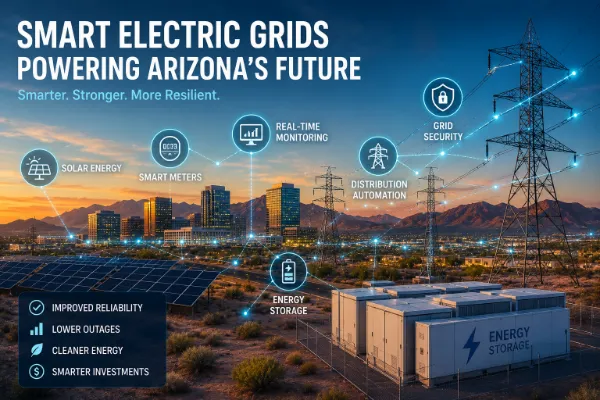
Smart electric grids address this challenge by combining physical electricity infrastructure with connected sensors, digital meters, automated distribution equipment, communications networks and advanced control systems.
In Arizona, grid modernization is becoming an operational necessity rather than simply a renewable energy initiative. The state's electricity networks must support residential cooling, semiconductor manufacturing, commercial development, data centers, electric vehicle charging and increasingly complex distributed energy resources.
Electricity infrastructure has historically been planned around anticipated customer growth, seasonal consumption patterns and the expected operating life of physical assets. Arizona's recent demand records demonstrate why utilities increasingly need more detailed and frequently updated information.
According to announcements from Salt River Project and Arizona Public Service, both utilities experienced exceptionally high electricity demand during the summer of 2026.
| Utility |
Reporting Period |
Reported Peak Demand |
| SRP |
August 2024 |
8,205 MW |
| SRP |
August 2025 |
8,542 MW |
| SRP |
July 24, 2026 |
9,072 MW |
| APS |
July 9, 2025 |
8,527 MW |
| APS |
July 24, 2026 |
9,053 MW |
| APS |
August 2, 2026 |
9,164 MW |
Source: Published APS and SRP announcements. Recent figures were reported as preliminary. These utility-specific peaks occurred at different times and should not be added together to estimate statewide peak demand.
Comparing SRP's reported 2025 record with its July 2026 peak reveals an increase of approximately 6.2 percent. APS's August 2026 record was also substantially higher than its July 2025 reported peak.
These comparisons do not isolate the effects of population growth, industrial expansion or weather. However, they demonstrate the scale of demand that Arizona utilities must be prepared to serve.
The underlying challenge is not simply producing enough electricity annually. It is ensuring that sufficient power can reach customers through transmission lines, substations and local distribution equipment precisely when demand is highest.
Arizona's power system includes natural gas generation, nuclear energy, solar resources, hydroelectric generation, battery storage and other electricity sources.
The U.S. Energy Information Administration's Arizona energy analysis reports that natural gas supplied approximately 45 percent of the state's in-state electricity generation in 2024, while solar supplied approximately 13 percent. Arizona also hosts the Palo Verde Nuclear Generating Station, a major source of electricity for the southwestern United States.
However, having substantial generation resources does not guarantee that every commercial development or residential neighborhood has sufficient local electrical capacity.
Electricity infrastructure operates across several interconnected layers:
- Generation: Power plants, solar facilities and other resources produce electricity.
- Transmission: High-voltage networks transport electricity across large geographical areas.
- Substations: Electrical infrastructure transforms voltage and connects different parts of the network.
- Distribution: Local feeders, transformers and related equipment deliver electricity to customers.
- Customer-side resources: Buildings, batteries, solar installations and controllable electrical loads consume or supply energy.
A constraint at any one of these layers can influence the ability to serve additional customers.
For example, a utility may have adequate generation resources across its overall system while an individual distribution area requires infrastructure upgrades before accommodating a major new commercial development.
Smart grid technology provides more detailed operational information about these different layers. It does not eliminate physical capacity limitations, but it can help utilities identify where investment, maintenance or flexible demand management may be most valuable.
A smart electric grid is not a separate type of electricity network. It is an existing or newly constructed power system enhanced with digital monitoring, communications, analytical software and automated control capabilities.
The distinction becomes clearer when examining how different grid management technologies contribute to utility operations.
| Grid Technology |
Primary Function |
Operational Value |
| Advanced Metering Infrastructure (AMI) |
Collect customer electricity usage and meter information |
Improved consumption visibility and outage awareness |
| SCADA |
Monitor and supervise electrical infrastructure |
Greater visibility into operating conditions |
| Advanced Distribution Management System (ADMS) |
Coordinate distribution network monitoring and management |
Improved operational decision-making |
| Outage Management System (OMS) |
Organize outage information and restoration activities |
Improved incident coordination |
| Distributed Energy Resource Management System (DERMS) |
Coordinate supported distributed energy resources |
Improved management of batteries, solar and flexible loads |
| Geographic Information System (GIS) |
Maintain geographical and asset-related information |
Better infrastructure planning and asset management |
| Asset Performance Management |
Analyze equipment condition and maintenance information |
Risk-based maintenance and replacement planning |
The most significant benefits arise when these systems exchange reliable information. A smart meter may identify an interruption, while an outage management platform organizes incoming information and a distribution management system provides additional network context to authorized utility operators.
Implementing these technologies requires more than purchasing connected equipment. Accurate asset records, consistent data formats, communications reliability and clearly defined operational responsibilities are equally important.
Our broader guide to smart utilities in Arizona examines how similar principles apply across electricity, water and other public infrastructure.
Salt River Project's grid planning activities illustrate how electricity providers are integrating digital management systems with conventional infrastructure investment.
According to SRP's Integrated System Plan, the utility deployed an advanced distribution management system and a distributed energy resource management system in January 2025.
These systems address related but distinct operational requirements.
An advanced distribution management system helps utilities maintain a more comprehensive understanding of distribution network conditions. A distributed energy resource management system focuses on coordinating supported resources such as customer batteries, distributed generation and flexible electricity consumption.
As more resources connect throughout the distribution network, utilities need to understand not only how much electricity customers consume but also when they generate electricity, store energy or change their consumption in response to external conditions.
This represents a fundamental change from distribution networks designed predominantly around electricity flowing from centralized generation toward customers.
SRP's deployment is an example of actual grid modernization activity in Arizona. It should not, however, be interpreted as proof that every distribution constraint has been resolved or that specific reliability improvements have already been achieved. Those outcomes require separate operational measurement.
Arizona has substantial solar energy resources, but solar electricity production and customer electricity demand do not always reach their maximum levels simultaneously.
During summer afternoons, solar generation may be producing significant electricity while air-conditioning demand remains high. As evening approaches, solar output declines even though homes and commercial properties may continue requiring substantial cooling.
The resulting operational challenge concerns net load: the amount of electricity demand remaining after accounting for generation from resources such as solar.
Consider a simplified hypothetical electricity system:
| Time of Day |
Electricity Demand |
Solar Generation |
Remaining Demand |
| 12:00 p.m. |
6,000 MW |
2,500 MW |
3,500 MW |
| 3:00 p.m. |
7,500 MW |
2,200 MW |
5,300 MW |
| 5:00 p.m. |
8,000 MW |
1,200 MW |
6,800 MW |
| 7:00 p.m. |
7,800 MW |
100 MW |
7,700 MW |
| 9:00 p.m. |
6,800 MW |
0 MW |
6,800 MW |
These figures are hypothetical and are intended to explain net load behavior. They do not represent measured Arizona utility operations.
In this example, total electricity demand decreases slightly between 5 and 7 p.m., but the amount of demand remaining after solar generation increases by 900 MW.
This illustrates why utilities need resources capable of responding to changes in both electricity consumption and renewable generation.
Connected energy management systems, battery storage, flexible generation, demand response and regional electricity exchanges can all contribute to addressing this requirement.
Our analysis of Arizona solar installations as connected energy systems explores how smart inverters, batteries and monitoring infrastructure contribute to this increasingly interconnected electricity environment.
Traditional electricity networks primarily respond to increased customer demand by obtaining additional electricity or dispatching available generation resources.
Virtual power plants introduce another possibility: coordinating distributed resources so that participating customers collectively provide a useful electricity system service.
These resources may include residential batteries, connected thermostats, commercial energy management systems and other eligible controllable devices.
A virtual power plant does not necessarily produce electricity in the conventional sense. Depending on its participating resources, it may reduce electricity consumption, release stored energy or coordinate both activities.
APS provides a documented Arizona example of coordinated customer-side energy flexibility.
According to its official virtual power plant information, APS programs collectively reduced electricity demand by 190 MW in 2024, including contributions from its Cool Rewards program.
Connected thermostats can support this type of program by adjusting participating customers' cooling demand according to program conditions. Other distributed resources may provide additional forms of grid flexibility.
The 190 MW figure demonstrates that aggregating relatively small individual resources can create a meaningful system-level contribution. It does not mean that the same amount of capacity is continuously available throughout the year.
Tucson Electric Power offers another approach through its Energy Storage Rewards program.
The program compensates eligible participating residential customers for making stored battery energy available during designated events when the electricity grid requires additional support.
Battery-based programs differ from thermostat-based demand response because stored energy can help supply electricity rather than relying exclusively on reduced consumption.
Actual participation requirements, incentives, equipment compatibility and program availability should be verified directly with the relevant electricity provider.
A useful way to understand aggregated demand response is to examine a hypothetical group of connected resources.
Suppose 10,000 participating devices each provide an average verified demand reduction of 0.8 kW during an event.
10,000 devices × 0.8 kW = 8,000 kW, or 8 MW.
If this reduction remains available for two hours, the associated reduction in electricity consumption during the event would be approximately 16 MWh.
The distinction between MW and MWh matters. Megawatts describe the rate at which electricity is generated or consumed. Megawatt-hours describe an amount of energy over time.
Utilities must also account for participant availability, equipment limitations, customer overrides, weather conditions and the duration for which flexibility can be sustained.
Distributed resources can complement conventional generation and infrastructure investment, but they should not automatically be treated as equivalent replacements for every type of electrical capacity.
Extreme heat affects electricity networks through more than increased air-conditioning demand.
Transformers, cables and other electrical equipment operate within defined thermal and electrical limits. High ambient temperatures can influence equipment cooling and available operating margins.
When unusually high customer demand coincides with demanding environmental conditions, utilities need reliable information about asset condition and operational loading.
Connected asset monitoring can provide information about equipment temperatures, electrical loading, voltage conditions and maintenance history.
This information supports several types of infrastructure decisions:
- Identifying equipment requiring additional engineering assessment.
- Prioritizing maintenance according to measured condition and operational importance.
- Comparing expected electricity demand with available infrastructure capacity.
- Evaluating where equipment replacement or expansion may be necessary.
- Distinguishing temporary seasonal loading from longer-term demand growth.
Predictive maintenance is particularly useful when it combines measured asset conditions with historical information rather than relying exclusively on fixed equipment replacement schedules.
However, analytical predictions remain dependent on data quality, equipment characteristics and appropriate engineering interpretation. Sensor information supports infrastructure decisions; it does not independently establish that an electrical asset is safe or suitable for additional loading.
Advanced electricity meters are often the most visible part of utility modernization because they directly connect customers with electricity consumption information.
Depending on the technology and utility configuration, advanced metering infrastructure can support automated readings, interval usage records, outage notifications and additional customer-facing services.
However, installing smart meters does not automatically create a fully automated electricity distribution network.
Meter data must be integrated with billing platforms, outage management systems, asset records and other utility software to create broader operational value.
Additionally, metering systems have different reporting intervals and communications capabilities. Electricity consumption information available through a customer portal may not provide the same timing or technical detail as utility operational monitoring systems.
These distinctions are especially important during large technology transitions. Our guide to smart meter rollout delays and software integration in Arizona examines why data validation, legacy system compatibility and operational readiness matter as much as the physical installation of new meters.
Semiconductor manufacturing, data centers, automated warehouses and advanced industrial facilities can introduce substantial and sometimes highly concentrated electricity requirements.
The implications for utilities depend on the facility's expected electrical demand, operating schedule, power quality requirements and geographical connection to existing infrastructure.
Two developments with similar annual electricity consumption may create very different infrastructure requirements if one operates continuously while the other experiences short periods of exceptionally high demand.
Grid planning therefore requires information about load profiles rather than simply annual consumption estimates.
Industrial developers should distinguish between several electricity-related questions:
| Planning Requirement |
Why It Matters |
| Expected maximum electrical demand |
Influences required service and infrastructure capacity |
| Daily operating profile |
Helps determine when electricity demand occurs |
| Power quality requirements |
Identifies requirements for sensitive equipment and production processes |
| Future expansion plans |
Supports longer-term capacity and infrastructure planning |
| On-site generation and storage |
May influence electricity consumption and interconnection requirements |
| Flexible electricity consumption |
May create opportunities for demand management programs |
| Continuity and backup requirements |
Helps establish facility-specific resilience requirements |
Developers should engage their electricity provider early in the project planning process. The availability of electricity service elsewhere in a metropolitan area does not establish that sufficient capacity is immediately available at a particular property.
Connected factory equipment and behind-the-meter energy IoT systems can complement utility planning by providing more accurate information about a facility's actual consumption patterns.
Smart grid projects are frequently described as investments in electricity reliability. Evaluating that claim requires measurable results rather than simply counting installed sensors or upgraded software platforms.
Utilities and regulators commonly use reliability indicators to evaluate customer interruption experiences.
| Reliability Indicator |
Meaning |
| SAIDI |
Average cumulative duration of sustained electricity interruptions experienced per customer during a reporting period |
| SAIFI |
Average frequency of sustained electricity interruptions per customer during a reporting period |
| CAIDI |
Average restoration duration for sustained customer interruptions |
| Customer interruption minutes |
Total customer exposure to electricity interruptions |
| Peak demand reduction |
Verified reduction in electricity demand during a defined period or event |
| Asset condition trends |
Changes in measured equipment conditions that inform maintenance planning |
These indicators help distinguish different modernization outcomes. A utility might reduce average restoration times without necessarily reducing the frequency of all interruptions.
Comparisons also require consistent reporting methods, including the treatment of major weather events and other exceptional circumstances.
Automation can support outage detection, operational coordination and service restoration. Nevertheless, severe weather, equipment damage and other physical infrastructure failures can still interrupt electricity service.
A modernized grid should be evaluated according to documented reliability outcomes rather than an expectation that connected technology will eliminate every outage.
As electricity providers integrate digital meters, connected equipment, operational software and communications networks, cybersecurity becomes increasingly important to the reliability of the overall system.
Utility environments differ from conventional commercial IoT installations because digital systems may support essential physical infrastructure and operational processes.
Grid modernization programs should therefore incorporate cybersecurity governance, supplier evaluation, controlled access, equipment lifecycle management, incident preparedness and operational continuity planning.
The NIST Cybersecurity Framework provides a recognized foundation for organizational cybersecurity risk management.
Electricity providers must also determine which industry-specific standards and regulatory obligations apply to their facilities, systems and operational responsibilities.
Introducing additional digital connectivity without appropriate cybersecurity governance can create new operational dependencies. Security, reliability and infrastructure modernization should consequently be evaluated as interconnected requirements.
Grid modernization occurs primarily within utility infrastructure, but businesses can contribute through better management of their own electrical systems.
The most useful starting point is determining whether a facility's primary problem concerns electricity consumption, peak demand costs, equipment reliability, service capacity or operational continuity.
Each problem requires a different combination of technologies and professional services.
| Business Objective |
Potential Technology |
Expected Information or Capability |
| Understand electricity consumption |
Energy submeters and monitoring platforms |
Equipment-level or circuit-level usage visibility |
| Manage peak demand |
Building controls and energy management software |
Identification and management of eligible flexible loads |
| Evaluate power quality |
Professional electrical monitoring equipment |
Documented electrical performance information |
| Integrate solar and batteries |
Compatible inverters and energy management systems |
Coordinated generation, storage and consumption |
| Improve operational continuity |
Engineered backup power and monitoring systems |
Facility-specific resilience capabilities |
| Participate in utility programs |
Eligible connected devices and program integrations |
Verified demand flexibility or energy storage participation |
Businesses should evaluate their actual electricity tariff, operating requirements and existing equipment before selecting a technology.
A facility's energy monitoring system cannot independently increase the capacity of utility-owned infrastructure. Similarly, installing batteries does not automatically establish that a building can operate independently during an outage.
Those outcomes depend on engineering design, utility coordination, equipment capabilities and applicable interconnection requirements.
Organizations developing connected commercial energy systems can explore our guide to IoT building energy management in Arizona for practical approaches to facility-level monitoring and performance evaluation.
Arizona's recent electricity demand records highlight the importance of coordinating infrastructure investment with increasingly sophisticated grid management capabilities.
New generation resources, substations, transmission facilities and distribution equipment remain essential where physical capacity must expand. Digital systems can help utilities understand how those resources are performing, where additional investment is needed and how distributed energy resources might contribute to operational flexibility.
Virtual power plants, advanced distribution management systems and connected asset monitoring demonstrate that electricity customers and digital infrastructure are becoming more closely integrated with utility operations.
The long-term success of smart electric grids in Arizona should be measured through reliable electricity delivery, effective infrastructure investment, verified demand flexibility, secure operations and the ability to support economic growth under increasingly demanding environmental conditions.
A smarter grid is not necessarily the grid with the most connected devices. It is the grid that uses accurate information and coordinated resources to make better infrastructure decisions while continuing to provide dependable electricity service.
Frequently asked questions
A smart electric grid combines conventional electricity infrastructure with digital monitoring, communications, automated equipment and analytical software. These technologies improve visibility into electricity consumption, equipment conditions, distributed energy resources and network operations.
Arizona experiences substantial summer electricity demand, population growth, industrial development and increasing adoption of distributed solar and battery storage. Grid modernization helps utilities manage these changing requirements while supporting infrastructure reliability and capacity planning.
APS operates programs that coordinate eligible customer-owned technologies to provide electricity demand flexibility. According to APS, its combined virtual power plant programs, including Cool Rewards, reduced electricity demand by 190 MW in 2024.
An advanced distribution management system supports monitoring and management of electricity distribution networks. A distributed energy resource management system focuses on coordinating supported distributed resources such as solar installations, batteries and flexible electricity loads.
Smart grids can improve outage awareness, equipment monitoring and operational coordination, potentially reducing certain interruptions or restoration times. They cannot eliminate all outages caused by extreme weather, equipment damage or physical infrastructure limitations.
Solar electricity production declines during the evening, while customer electricity demand may remain elevated. Battery storage can make previously stored energy available during periods when solar production is lower or electricity demand is higher.
No. Smart meters are one component of a modern electricity network. Smart grids also include distribution management software, connected infrastructure, communications systems, automated equipment and distributed energy management capabilities.
Businesses may benefit from improved electricity usage information, better infrastructure planning and opportunities to participate in eligible demand management programs. Individual benefits depend on the electricity provider, facility requirements, applicable tariffs and available technologies.
Related articles

 Smart Utilities