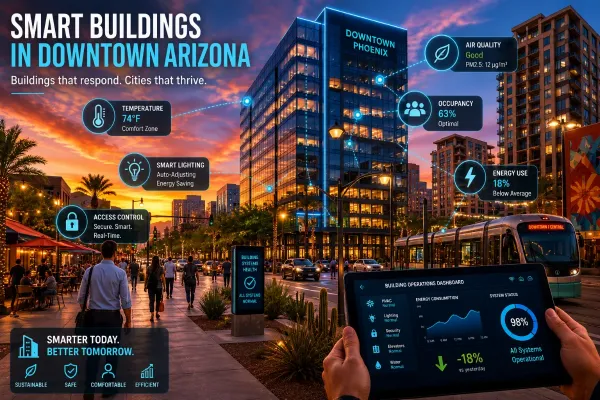
Beneath downtown Phoenix, an underground network of chilled water pipes connects commercial buildings, entertainment venues, convention facilities and university campuses. Instead of relying exclusively on individual cooling plants, these properties receive chilled water from centralized facilities designed to support the cooling requirements of an entire urban district.
This infrastructure, known as a district cooling system, has been serving downtown Phoenix since 2001. Its significance is becoming increasingly apparent as the city accommodates new research laboratories, healthcare facilities, commercial developments and rising summer cooling requirements.
District cooling also changes how smart buildings are designed and managed. Building automation systems, thermal energy meters, connected sensors and centralized energy infrastructure must work together to maintain indoor conditions while managing electricity demand, water consumption and equipment performance.
Downtown Phoenix provides a documented example of how individual smart buildings can become part of a larger urban energy system.
Commercial buildings in dense urban areas require substantial cooling infrastructure. Under a conventional arrangement, each property may operate its own chillers, cooling towers, pumps and associated mechanical equipment.
This approach gives property owners direct control over their cooling production but also introduces equipment installation, maintenance, replacement and space requirements.
District cooling provides an alternative by producing chilled water at centralized plants and distributing it to participating buildings through insulated underground pipes.
Downtown Phoenix is particularly suitable for examining this approach because its urban core contains properties with different cooling demand patterns.
Office buildings typically experience greater activity during business hours. Hotels and residential developments require cooling across longer operating periods. Entertainment venues can experience substantial increases in occupancy during scheduled events, while research facilities may require carefully maintained environmental conditions throughout the day.
These different operating profiles can create opportunities for coordinated cooling production, although the extent of the benefit depends on actual demand patterns and system design.
For Arizona developers, shared cooling infrastructure introduces a different approach to managing mechanical equipment, electrical capacity and valuable urban building space.
A district cooling system transfers heat from individual buildings to centralized cooling infrastructure.
Although the chilled water production equipment may be located outside the customer's property, the building retains its own air distribution and indoor environmental control systems.
The process generally involves five interconnected stages.
- Chilled water production: Centralized chillers reduce the temperature of circulating water using refrigeration equipment.
- Water distribution: Pumps circulate chilled water through insulated supply pipes to participating buildings.
- Building heat exchange: Chilled water transfers cooling capacity to the property's mechanical systems through an appropriate interface.
- Indoor cooling: Air handling equipment and other compatible systems use the available cooling capacity to maintain required building conditions.
- Return water circulation: Water carrying absorbed heat returns through the district network for cooling and recirculation.
Depending on the installation, a building may use heat exchangers to separate its internal chilled water circuit from the district distribution network.
This arrangement allows centralized cooling production and individual building operation to remain connected while maintaining appropriate mechanical and operational boundaries.
Building managers still need to maintain air handling equipment, control valves, temperature sensors, ventilation systems and other property-level infrastructure.
Our guide to commercial building automation systems in Arizona explains the controllers and supervisory software supporting these local functions.
The Phoenix Convention Center provides one of the clearest publicly documented examples of district cooling in Arizona.
According to the convention center's chilled water plant documentation, the facility contains more than one million square feet of meeting and event space across three buildings.
A Cordia-operated cooling plant located beneath the convention center contributes to the downtown district cooling network, which includes approximately four miles of chilled water distribution pipes.
The network has historically supported major downtown properties, including Chase Field, university facilities, hotels and commercial buildings.
These properties illustrate the diversity of cooling requirements within a shared urban infrastructure system.
A convention center hosting a large event may experience substantial changes in cooling demand over a short period. A research facility may require more consistent environmental conditions, while a hotel must accommodate different guest occupancy patterns.
Centralized cooling infrastructure must account for these variations while maintaining the required supply conditions across the distribution network.
Unlike a hypothetical smart city concept, Phoenix district cooling is an established infrastructure application operating within an existing urban environment.
The American Society of Heating, Refrigerating and Air-Conditioning Engineers (ASHRAE) published technical information about Energy Center Phoenix as part of its 2025 annual conference facility tours.
The ASHRAE facility description identified three interconnected cooling plants serving more than 40 downtown customers.
It also described approximately 28,000 refrigeration tons of cooling at peak operating conditions and thermal energy storage equipment used to help manage peak demand.
These figures describe the infrastructure as presented in 2025. They should not be interpreted as a complete inventory of every cooling asset operating in downtown Phoenix today.
The documented arrangement demonstrates how cooling production, distribution and energy storage can operate as interconnected components rather than independent mechanical systems within each building.
The continued development of the Phoenix Bioscience Core is creating additional requirements for dependable cooling infrastructure.
On March 20, 2026, Cordia announced that it had broken ground on Energy Center Phoenix Plant 4, an expansion of its downtown district cooling system.
According to the company's official project announcement, the expansion represents an investment of approximately $75 million.
| Project characteristic |
Announced specification |
| Project |
Energy Center Phoenix Plant 4 |
| Location |
Phoenix Bioscience Core |
| Announced investment |
Approximately $75 million |
| Additional cooling capacity |
10,200 refrigeration tons |
| Chiller configuration |
Six 1,700-ton chillers |
| Electricity supply arrangement |
Announced carbon-free electricity partnership with APS |
| Project status |
Groundbreaking announced in March 2026 |
| Expected operating period |
2027, according to announced project plans |
The additional infrastructure is intended to support growing commercial, academic and research-related cooling requirements within downtown Phoenix.
In January 2026, Cordia also announced a 20-year chilled water service agreement for the new ASU Health headquarters.
These announcements illustrate how district cooling can influence long-term development decisions. Developers can evaluate access to centralized cooling infrastructure during building design instead of automatically allocating space and capital toward independent cooling production.
The Plant 4 capacity figures describe the announced expansion. They do not establish that the additional cooling equipment is already operational.
District cooling changes where refrigeration equipment operates and how property owners obtain cooling capacity. It does not eliminate the need for building-level HVAC infrastructure.
A commercial office connected to district cooling may still require air handling units, circulation pumps, control valves, ventilation equipment and environmental sensors.
The appropriate cooling arrangement depends on the building's location, cooling demand, mechanical design and financial requirements.
| Evaluation factor |
Individual building cooling plant |
District cooling system |
| Cooling production |
On-site refrigeration equipment |
Centralized cooling facilities |
| Capital investment |
Owner generally funds cooling production equipment |
Connection costs and service arrangements replace some on-site investment |
| Mechanical space |
May require substantial chiller and heat rejection infrastructure |
May reduce space required for cooling production |
| Maintenance |
Owner maintains primary cooling equipment |
Responsibilities divided between district operator and building owner |
| Operating flexibility |
Direct control over on-site production |
Subject to service agreement and available supply conditions |
| Energy storage |
Requires a property-level installation |
May be provided through shared thermal storage infrastructure |
| Service availability |
Depends on building equipment and supporting infrastructure |
Depends on district network, connection and building-side equipment |
District cooling is not automatically less expensive or more efficient for every commercial property.
Financial performance depends on service pricing, contracted cooling capacity, connection costs, building operating conditions and the expenses associated with alternative HVAC systems.
Developers should compare complete lifecycle costs rather than assume that eliminating on-site chillers necessarily reduces total cooling expenditure.
Our article about reducing commercial building energy costs in Arizona provides further guidance on evaluating operating expenses and verifying efficiency improvements.
Cooling requirements in Phoenix can become particularly demanding during hot summer afternoons. Producing all required cooling at the same time that electrical demand is highest may increase infrastructure requirements and operating expenses.
Thermal energy storage provides a way to separate the time at which cooling is produced from the time at which that cooling is used.
Two common approaches involve storing chilled water or producing ice for subsequent use.
A chilled water storage system retains cooled water that can later contribute to the cooling requirements of connected buildings.
Depending on its design, the system may produce and store cooling during periods of lower demand and use the stored cooling during subsequent high-demand periods.
Ice storage uses refrigeration equipment to freeze water during a charging period. The stored thermal capacity can subsequently support cooling production as the ice melts.
ASHRAE's 2025 description of Energy Center Phoenix identifies ice storage infrastructure within two of the interconnected plants.
One documented storage tank has a capacity of 36,000 ton-hours.
A ton-hour represents thermal cooling energy rather than electrical energy consumption. A storage system's electrical requirements depend on refrigeration efficiency, pumping requirements and other operating conditions.
Consider a hypothetical cooling system that needs to provide an additional 2,000 refrigeration tons of cooling for three hours during an afternoon demand period.
If sufficient thermal storage capacity is available, the system would need to deliver approximately 6,000 ton-hours of usable cooling energy during that period.
Some or all of this cooling could potentially be produced earlier and retained within the storage system.
The actual reduction in electrical demand would depend on chiller operation, storage efficiency, pumping requirements and the amount of mechanical cooling still required during discharge.
Thermal energy storage does not necessarily reduce total electricity consumption. Its principal advantage may instead involve shifting electrical demand to more suitable operating periods.
This distinction is important when evaluating peak electrical demand management for Arizona businesses.
District cooling requires coordinated information about cooling production, distribution conditions and individual building demand.
Traditional industrial control systems already support many of these responsibilities. Modern IoT integration can extend available information through additional sensors, remote monitoring and analytical applications.
Potential monitoring points include chilled water supply and return temperatures, water flow rates, hydraulic pressure, electrical consumption and equipment operating status.
These measurements help operators understand whether cooling is being produced efficiently, distributed appropriately and used effectively by connected buildings.
However, a connected sensor does not independently determine whether a district cooling system is operating efficiently. The information must be interpreted according to the system's mechanical design and operating conditions.
Plant-level monitoring may include chiller operation, pump performance, cooling tower conditions, thermal storage availability and electrical demand.
These observations can support equipment scheduling, maintenance investigations and operating performance evaluation.
Distribution-level measurements may include water pressure, flow and temperature at selected locations within the network.
These observations help qualified personnel investigate whether the system is delivering suitable cooling conditions to participating properties.
Individual buildings may monitor cooling energy consumption, heat exchanger performance, control valve behavior and indoor environmental conditions.
Building managers can use this information to distinguish problems originating within their property from issues requiring communication with the district cooling provider.
Our overview of building energy management systems in Arizona examines how connected measurements can support commercial property management.
These are representative district cooling monitoring applications. They are not a verified inventory of specific IoT devices or communication protocols installed within Cordia's Phoenix facilities.
A district cooling network transfers thermal energy through circulating water. The amount of useful cooling delivered depends partly on water flow and the temperature difference between the supply and return circuits.
This temperature difference is commonly referred to as delta T.
When chilled water enters a building and absorbs heat, its temperature increases before returning to the cooling network.
A sufficiently maintained temperature difference helps the system deliver the required thermal energy using an appropriate amount of circulating water.
When the temperature difference becomes smaller than intended, additional water flow may be necessary to deliver the same cooling capacity.
For ordinary water under common HVAC operating assumptions, approximate cooling capacity can be estimated using the following engineering relationship:
Cooling capacity in BTU per hour = 500 × water flow in gallons per minute × temperature difference in degrees Fahrenheit.
Consider a hypothetical commercial building requiring 250 refrigeration tons of cooling.
One refrigeration ton is equivalent to approximately 12,000 BTU per hour. Therefore, the building requires approximately three million BTU per hour of cooling.
| Illustrative operating condition |
Required water flow |
| 12°F supply-to-return temperature difference |
500 gallons per minute |
| 8°F supply-to-return temperature difference |
750 gallons per minute |
| 6°F supply-to-return temperature difference |
1,000 gallons per minute |
Under these simplified assumptions, reducing the temperature difference from 12°F to 6°F doubles the water flow required to deliver the same cooling capacity.
In an actual installation, water properties, equipment behavior and measurement accuracy influence the calculation.
These examples are hypothetical engineering illustrations, not measured operating conditions from Phoenix's district cooling network.
They demonstrate why connected temperature and flow measurements can be valuable for investigating building performance and distribution requirements.
Low delta T syndrome describes a condition in which a chilled water system operates with a smaller temperature difference than intended.
Potential causes may include excessive water flow, malfunctioning control valves, inappropriate control sequences, inefficient heat transfer or unsuitable operating conditions.
In an individual building, these problems may influence pumping requirements and cooling equipment performance.
Within a district cooling network, inefficient building-side operation can also create additional distribution requirements for the shared infrastructure.
Building automation systems can help maintenance personnel investigate relevant conditions by combining temperature observations, water flow information and equipment operating records.
For example, a building reporting high chilled water flow alongside relatively limited heat transfer may require an investigation of its control valves, air handling equipment or measurement accuracy.
A low temperature difference alone does not establish the cause of the problem. Qualified mechanical and controls professionals should investigate the relevant operating conditions before implementing changes.
Buildings connected to district cooling may require thermal energy metering to measure the cooling energy delivered through their connection.
A thermal energy meter generally combines water flow measurements with supply and return temperature information.
The resulting thermal energy records can support operating analysis and, depending on contractual arrangements, service billing.
Cooling capacity and cooling consumption should be distinguished.
A building requiring 300 refrigeration tons at a particular moment is reporting a rate of thermal energy transfer. If it maintains that cooling requirement for four hours, it consumes approximately 1,200 ton-hours of thermal cooling energy.
Commercial property managers should understand how their cooling service agreement treats consumption, contracted capacity and other applicable charges.
Connected building analytics may also help investigate unusual consumption patterns, including excessive cooling during unoccupied periods or changes in demand that do not correspond with expected building activity.
However, rising cooling consumption does not automatically indicate equipment inefficiency. Outdoor weather conditions, tenant occupancy, operating hours and building modifications can influence cooling requirements.
Water consumption is an important consideration when evaluating large cooling systems in the desert Southwest.
Water circulating through a closed chilled water distribution network is primarily used to transfer thermal energy. It is not normally consumed in the same way as water used for irrigation or domestic purposes.
However, cooling production may involve additional systems that consume water.
Water-cooled chillers frequently use cooling towers to reject heat. These towers can consume water through evaporation, controlled discharge and other operating losses.
Consequently, a district cooling system should not automatically be described as water-saving simply because it uses centralized equipment.
Its water performance depends on refrigeration technology, heat rejection methods, operating conditions and water management practices.
Relevant performance indicators may include makeup water consumption, cooling tower operating conditions, water treatment requirements and cooling energy delivered.
Comparisons should examine both water consumption and electricity requirements across equivalent cooling applications.
An alternative cooling technology that reduces direct water consumption may require more electricity under certain operating conditions. Conversely, a highly efficient water-cooled installation may reduce electrical requirements while consuming water through evaporative heat rejection.
These trade-offs are particularly relevant to Arizona's wider energy and sustainability infrastructure.
Mixed-use urban districts contain buildings with different occupancy schedules and mechanical requirements.
Office space, residential towers, restaurants, hotels, event facilities and academic buildings do not necessarily experience their maximum cooling demand at the same time.
District energy planning can evaluate these differences through load diversity analysis.
Consider three hypothetical connected properties.
- An office building with a maximum cooling requirement of 500 tons.
- A hotel with a maximum cooling requirement of 400 tons.
- An entertainment facility with a maximum cooling requirement of 600 tons.
The sum of their individual maximum requirements is 1,500 refrigeration tons.
However, if their peaks occur at different times, the combined district demand may remain below that figure.
The actual diversity benefit would need to be established using representative operating profiles, weather conditions and appropriate reliability requirements.
This example explains why centralized infrastructure planning may differ from the process of independently sizing cooling equipment for every property.
It does not establish that a district cooling plant should be designed below its required operating capacity or without appropriate redundancy.
Centralized cooling introduces shared infrastructure dependencies that must be considered during property development.
Although a district system may contain multiple cooling plants and equipment redundancy, individual buildings still depend on their connection, internal mechanical systems and the availability of suitable cooling service.
A failure affecting a building-side pump, heat exchanger or air handling system can interrupt indoor cooling even when the district network remains available.
Conversely, a problem affecting shared distribution infrastructure may influence several connected properties.
Property owners should therefore establish where equipment ownership, maintenance responsibilities and operational response duties are divided.
These considerations are especially important for Arizona healthcare facilities, research laboratories and other properties requiring dependable environmental conditions.
Connected monitoring can help identify abnormal conditions and communicate relevant equipment information, but it cannot replace appropriate mechanical redundancy, emergency planning and maintenance arrangements.
Our article on smart building resilience during Arizona's extreme heat discusses the broader importance of maintaining essential building services.
Access to a district cooling network can influence building design, capital investment and long-term operating responsibilities.
Before selecting a cooling arrangement, developers should determine whether service is available at the proposed property and whether the network can support the intended cooling requirements.
A technical and financial assessment should consider:
- Expected annual and peak cooling demand.
- Available district cooling capacity.
- Connection and building-side installation costs.
- Cooling service pricing and contractual obligations.
- Required supply and return water conditions.
- Thermal energy metering requirements.
- Mechanical space that may become available for other uses.
- Maintenance responsibilities and service availability provisions.
- Building automation and monitoring compatibility.
- Future changes in occupancy and cooling demand.
Property owners should also compare the financial implications of district cooling with suitable independent cooling alternatives across the expected building lifecycle.
For some developments, reducing on-site mechanical equipment may provide meaningful design flexibility. Other properties may have operating requirements that favor independent or supplementary cooling infrastructure.
The decision should reflect actual service conditions and building requirements rather than a general assumption that centralized infrastructure is always preferable.
The development of district cooling in Phoenix demonstrates that smart building performance does not depend exclusively on the technology installed within an individual property.
Buildings increasingly operate within wider infrastructure networks involving electricity, water, communications and shared mechanical services.
Connected measurements can help property owners understand how their building interacts with these systems, while centralized infrastructure can create opportunities for coordinated resource management.
The expansion announced at the Phoenix Bioscience Core illustrates how cooling infrastructure can be planned alongside new urban development rather than treated as an isolated mechanical requirement for each property.
However, district cooling should be evaluated through actual engineering performance, water consumption, service reliability and financial conditions.
The most meaningful measure of a smart downtown is not the number of connected buildings or installed sensors. It is whether the underlying infrastructure can maintain dependable indoor conditions while supporting responsible long-term resource use.
Frequently asked questions
A district cooling system produces chilled water at centralized facilities and distributes it through a network of pipes to connected buildings. Individual properties use the supplied cooling capacity within their own mechanical and air conditioning systems.
Yes. Downtown Phoenix has an established district cooling network that distributes chilled water through underground pipes to participating commercial buildings, convention facilities, entertainment venues and university properties.
Publicly documented examples include the Phoenix Convention Center, Chase Field and university facilities in downtown Phoenix. The complete customer list and current connection arrangements should be confirmed with the district cooling provider.
Conventional commercial cooling systems may produce chilled water or refrigeration directly within an individual property. District cooling produces cooling centrally and distributes chilled water to connected buildings. Building-level air handling and environmental control equipment are still required.
District cooling can provide opportunities for efficient equipment operation, shared infrastructure and thermal energy storage. Actual electricity savings depend on the system design, operating conditions, distribution requirements and the performance of alternative cooling systems.
Thermal energy storage retains cooling energy for later use, commonly through chilled water or ice storage. It can help shift cooling production away from periods of high electrical demand, although total energy savings depend on system efficiency and operating conditions.
IoT technology can support monitoring of water flow, temperature, pressure, cooling energy consumption and equipment operation. Connected information may help operators investigate abnormal conditions, coordinate maintenance and evaluate energy performance.
District cooling availability depends on local infrastructure. Downtown Phoenix has an established network, but individual buildings elsewhere in Arizona may require independent cooling systems or access to other campus or district energy infrastructure. Developers should confirm service availability at their specific property.
Related articles

 Construction & Real Estate