A commercial truck traveling between Phoenix and Tucson may generate hundreds of operational observations during a single journey. Vehicle location, engine temperature, fuel consumption, idling duration, diagnostic fault codes and delivery arrival times can reveal problems that traditional mileage records cannot explain.
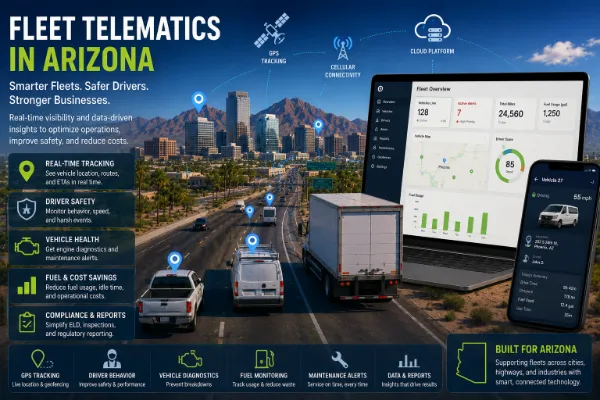
Fleet telematics in Arizona combines GPS fleet tracking, onboard vehicle diagnostics, wireless communication and fleet management software to monitor commercial vehicles and mobile equipment. These systems help transportation companies, contractors, utilities and municipal agencies understand how their vehicles are being used and where operational improvements may be possible.
Arizona presents distinct fleet management challenges, including extreme summer temperatures, long-distance freight corridors, remote service locations and growing requirements for electric fleet infrastructure. Effective telematics systems must account for these conditions rather than simply provide vehicle locations on a digital map.
Fleet operations in Arizona range from short urban service calls to interstate freight transportation and remote agricultural equipment deployment. Each operating environment creates different requirements for vehicle monitoring, communication coverage and maintenance planning.
The Arizona Department of Transportation's State Freight Plan examines the infrastructure needed to support freight movement throughout the state. ADOT began updating its previously approved 2022 plan, with additional planning activities taking place during 2026.
The state's major transportation corridors connect metropolitan distribution facilities, manufacturing operations, agricultural regions and international supply chains.
| Arizona freight corridor |
Representative fleet activity |
Relevant telematics capability |
| Interstate 10 |
Interstate freight and Phoenix–Tucson distribution |
Route monitoring, delivery predictions and fuel management |
| Interstate 17 |
Central and northern Arizona transportation |
Vehicle load, engine performance and maintenance monitoring |
| Interstate 40 |
Long-distance interstate trucking |
Electronic logging, vehicle diagnostics and communication resilience |
| Interstate 19 |
Cross-border freight and regional distribution |
Shipment tracking, arrival records and cold chain monitoring |
| Interstate 8 |
Agricultural and interstate transportation |
Remote vehicle tracking and temperature-sensitive freight monitoring |
| Phoenix metropolitan roads |
Last-mile delivery and field service operations |
Dispatch coordination, vehicle utilization and geofencing |
These are representative operating scenarios rather than claims that every fleet using these corridors has deployed the listed technologies.
ADOT also identifies the 26-mile I-10 Wild Horse Pass corridor between south Phoenix and the Casa Grande area as an important freight and commuter connection undergoing infrastructure improvements.
For fleet managers, changing roadway conditions reinforce the importance of combining vehicle telemetry with current transportation information. ADOT's AZ511 traveler information service provides highway conditions, traffic information and reported restrictions that can support dispatch planning.
A fleet telematics system establishes a communication pathway between vehicles, mobile equipment and fleet management applications.
Depending on the installation, the system may collect information from positioning equipment, vehicle electronic control modules, external sensors and driver-facing applications.
An onboard telematics device collects supported measurements, which may include vehicle position, speed, engine operating hours, diagnostic information and fuel-related data.
The exact measurements available depend on the vehicle manufacturer, model, electronic architecture and telematics device compatibility.
The telematics device may identify selected operating events, apply timestamps and retain information locally when communication becomes unavailable.
Local processing is particularly relevant to Arizona fleets operating outside metropolitan areas, where continuous mobile connectivity cannot always be guaranteed.
Vehicle information is transmitted through a suitable cellular or other communication network to a fleet management platform.
Reporting frequency may change according to vehicle movement, event severity, equipment configuration and network availability.
The management platform associates incoming measurements with individual vehicles, drivers, equipment records and operating schedules. It may also integrate with dispatch applications, maintenance software and transportation management systems.
Validated information can support dispatch changes, equipment inspections, driver coaching, maintenance work orders or financial reporting.
The value of fleet telematics therefore depends on the quality of both the collected measurements and the operational processes used to interpret them.
GPS fleet tracking and fleet telematics are related but not identical technologies.
A basic GPS tracking device primarily establishes the location and movement of a vehicle or asset. A comprehensive telematics system may combine positioning information with vehicle diagnostics, maintenance records, fuel consumption and operating events.
| Capability |
Basic GPS tracking |
Full fleet telematics |
| Vehicle location |
Typically supported |
Typically supported |
| Trip history |
Typically supported |
Typically supported |
| Geofence events |
Often supported |
Often supported |
| Engine diagnostic information |
Generally limited |
Available on compatible vehicles |
| Fuel consumption information |
Generally unavailable or estimated |
Available through supported measurements or integrations |
| Maintenance workflows |
May provide mileage-based reminders |
May integrate diagnostics, mileage and engine hours |
| Electric vehicle battery information |
Generally unavailable |
Available on compatible vehicles |
| Electronic logging compliance |
Not automatically supported |
Requires compatible registered ELD functionality where applicable |
A small landscaping business may only need vehicle location and job arrival records. An interstate trucking company may require electronic logging, engine diagnostics, fuel reporting and trailer monitoring.
Purchasing a more comprehensive fleet management platform is justified only when its additional capabilities address actual operating requirements.
Fleet management software cannot independently measure engine temperature, vehicle fault codes or fuel consumption. These measurements must originate from compatible vehicle systems or external monitoring equipment.
On-board diagnostics, commonly referred to as OBD-II, provide access to standardized diagnostic information on compatible vehicles.
Telematics devices connected through an appropriate diagnostic interface may retrieve supported information such as engine speed, vehicle speed, diagnostic trouble codes and selected operating parameters.
Not every desired measurement is available through the standardized OBD-II interface. Some functions require manufacturer-specific integrations.
CAN bus is a communication technology used by electronic systems within many vehicles. It allows compatible electronic control units to exchange information.
A vehicle may contain several communication networks serving different functions. Access to a diagnostic connector does not automatically provide unrestricted access to every vehicle system.
SAE J1939 defines communication practices used across compatible commercial vehicle and equipment networks.
The SAE J1939 technical documentation provides a foundation for communication between electronic components in heavy-duty vehicle applications.
Supported measurements may include engine operating conditions, diagnostic information, fuel-related parameters and equipment status.
| Data source |
Representative application |
Important limitation |
| GNSS/GPS positioning |
Vehicle location and movement |
Does not independently provide engine diagnostics |
| OBD-II interface |
Compatible light-duty vehicle diagnostics |
Available measurements vary by vehicle |
| CAN bus |
Vehicle electronic communication |
Requires appropriate access and protocol compatibility |
| SAE J1939 |
Commercial and heavy-duty equipment communication |
Not every supported parameter is available on every vehicle |
| External sensors |
Trailer temperature, tire pressure and equipment conditions |
Requires separate installation and validation |
| Manufacturer telematics API |
Access to supported connected vehicle information |
Depends on manufacturer policies and service availability |
Fleet operators with mixed vehicle inventories should verify compatibility at the individual make, model and model-year level before purchasing telematics equipment.
Connected vehicle monitoring is already an established component of Arizona municipal fleet operations.
A 2025 City of Phoenix contract record documents telematics hardware and monitoring services supporting more than 1,000 city vehicles.
The record identifies vehicle tracking and maintenance-related information as important functions supporting municipal operations.
This is a useful example of how telematics extends beyond commercial trucking. Public agencies also require reliable vehicle availability, equipment records and maintenance coordination to deliver essential services.
ADOT identifies GPS monitoring services for fleet equipment among its fleet and equipment procurement responsibilities.
These documented requirements demonstrate established public-sector demand for connected vehicle monitoring rather than merely projected future adoption.
Municipal fleet applications can also complement broader connected infrastructure initiatives across Arizona local governments.
Arizona fleet operators must account for environmental conditions that can increase the operational demands placed on vehicle cooling systems, batteries, tires and air conditioning equipment.
Telematics can help maintenance teams identify selected changes in vehicle operating behavior, particularly when measurements are compared against previous observations from similar operating conditions.
| Monitored parameter |
Potential condition to investigate |
Appropriate follow-up |
| Engine coolant temperature |
Abnormal cooling system performance |
Review operating conditions and arrange qualified inspection |
| Battery voltage |
Charging system or battery-related problems |
Evaluate battery and electrical system condition |
| Tire pressure |
Pressure deviations on compatible monitoring systems |
Verify pressure using approved inspection procedures |
| Diagnostic trouble codes |
Detected vehicle system abnormalities |
Interpret fault information with qualified maintenance personnel |
| Engine operating hours |
Higher equipment use than mileage alone indicates |
Review applicable maintenance intervals |
| Refrigeration equipment temperature |
Potential cold chain equipment problems |
Investigate equipment and cargo storage conditions |
| EV battery temperature |
Thermal conditions affecting vehicle operation or charging |
Follow manufacturer operating and service requirements |
A diagnostic trouble code identifies a reported abnormal condition, but it does not necessarily establish which component requires replacement.
For example, an elevated coolant temperature observation could relate to vehicle load, ambient conditions, coolant circulation problems or measurement issues. Replacing a component based solely on a single telematics alert may result in unnecessary maintenance expenditure.
The National Highway Traffic Safety Administration's summer driving guidance highlights the importance of vehicle maintenance, tire condition, cooling systems and preparedness during hot weather.
Combining connected vehicle data with established maintenance practices is more reliable than treating telematics as a replacement for physical inspection.
Similar measurement and maintenance principles apply to remote equipment monitoring systems across Arizona.
Fuel consumption is an important fleet operating expense, but total fuel use alone provides limited information about where avoidable consumption occurs.
Telematics can help distinguish fuel consumed while traveling from fuel associated with stationary engine operation.
However, not every idling event represents waste. Arizona service vehicles may require air conditioning, power take-off equipment, refrigeration or other operational functions while stationary.
Fleet managers should therefore distinguish necessary stationary engine operation from avoidable idling.
Consider a hypothetical fleet operating 50 commercial vehicles for 250 working days annually.
Assume that an operational review identifies 30 minutes of avoidable idling per vehicle per working day and that the vehicles consume an average of 0.8 gallons of fuel per hour during those particular idle conditions.
| Calculation input |
Illustrative value |
| Number of vehicles |
50 |
| Avoidable daily idling per vehicle |
0.5 hours |
| Annual operating days |
250 |
| Assumed idle fuel consumption |
0.8 gallons per hour |
| Assumed fuel price |
$3.75 per gallon |
| Annual avoidable idle time |
6,250 hours |
| Potential annual fuel reduction |
5,000 gallons |
| Potential annual gross fuel savings |
$18,750 |
The calculation is:
50 vehicles × 0.5 hours × 250 days × 0.8 gallons × $3.75 = $18,750 annually.
If the telematics platform costs an assumed $25 per vehicle per month, annual subscription costs would total $15,000.
Under these assumptions, the potential annual fuel benefit remaining after subscription costs would be $3,750, excluding hardware, installation, training and other expenses or benefits.
These are illustrative assumptions, not current Arizona fuel prices, vendor quotations or documented fleet savings.
The Department of Energy's idle reduction guidance explains how reducing unnecessary engine operation can conserve fuel and potentially reduce engine wear.
Actual financial performance should be evaluated using measured fleet-specific fuel consumption and realistic reductions in avoidable idling.
Driver cooling, health, safety and essential equipment operation must not be compromised to achieve fuel reduction targets.
Vehicle location information becomes more useful when integrated with service schedules, delivery requirements and road conditions.
For example, an HVAC service business operating across Phoenix, Mesa, Chandler and Scottsdale may experience unnecessary driving when dispatch assignments do not account for current crew locations and appointment requirements.
A connected dispatch platform can combine vehicle positions with work orders, technician availability and customer time windows.
However, the geographically closest vehicle is not always the most appropriate vehicle to assign. Required equipment, technician qualifications, existing commitments and estimated travel conditions may change the preferred assignment.
Commercial trucking introduces additional considerations, including vehicle restrictions, freight characteristics, driver operating-hour requirements and approved transportation routes.
Fleet routing applications should therefore account for vehicle and operational constraints rather than rely exclusively on ordinary passenger-car navigation.
For distribution operations, integrating fleet arrival estimates with smart warehouse sensor networks can help receiving teams coordinate loading dock activity with incoming shipments.
These applications also complement Arizona's intelligent transportation infrastructure, where regional traffic information supports transportation planning and dispatch decisions.
An electronic logging device (ELD) is designed to support applicable commercial driver hours-of-service recordkeeping requirements.
Although ELD platforms may include positioning and vehicle information, an ordinary GPS tracking device does not automatically satisfy federal ELD requirements.
The Federal Motor Carrier Safety Administration's ELD guidance explains the requirements applicable to drivers and motor carriers subject to the electronic logging rule.
| System capability |
GPS fleet tracking |
Electronic logging device |
| Vehicle location |
Primary operational function |
Recorded according to applicable ELD requirements |
| Driver duty status |
Not necessarily supported |
Core recordkeeping function |
| Engine synchronization |
Depends on device configuration |
Required in accordance with applicable specifications |
| Hours-of-service records |
Not automatically compliant |
Designed to support applicable recordkeeping requirements |
| Required inspection data transfer |
Generally not a standard capability |
Supported according to applicable ELD specifications |
Not every Arizona commercial vehicle or driver is subject to identical ELD requirements. Certain operations may qualify for exceptions or exemptions depending on applicable regulations and operating circumstances.
Motor carriers should review the FMCSA exemption guidance and consult qualified compliance professionals when necessary.
Organizations purchasing ELD equipment should also verify the specific device against the current FMCSA registered ELD list.
Devices on this list are registered and self-certified by their manufacturers. Registration should not be described as independent government certification of every product feature.
Fleet safety programs increasingly combine vehicle operating information with dash camera systems and event-based video review.
Video telematics can provide additional context when investigating selected incidents, abrupt braking events or other reported driving conditions.
However, accelerometer-based events and automated video classifications require careful interpretation.
For example, harsh braking may indicate aggressive driving, but it may also represent an appropriate response to an unexpected roadway hazard.
A driver safety program should distinguish between detected events and verified unsafe behavior.
Useful implementation practices include:
- Evaluating events in their actual operational context.
- Establishing transparent driver coaching procedures.
- Verifying the accuracy of automated event classifications.
- Normalizing safety indicators according to distance or operating exposure.
- Defining appropriate video retention and access policies.
- Providing procedures for reviewing disputed events.
Fleet operators should communicate clearly about which information is collected, why it is collected and how it may influence employment-related decisions.
Connected safety technology should support fair and evidence-based coaching rather than automatically assign responsibility for every detected event.
Tracking a tractor does not necessarily establish the location or environmental condition of the trailer it previously transported.
Independent trailer monitoring becomes particularly relevant when trailers are transferred between vehicles, stored in yards or used for temperature-sensitive freight.
Southern Arizona agricultural distribution and cross-border produce logistics create applications for connected trailer monitoring.
| Trailer monitoring device |
Operational information |
| Independent positioning device |
Trailer location and movement history |
| Temperature sensor |
Environmental conditions within selected cargo areas |
| Door contact sensor |
Trailer access events and opening duration |
| Refrigeration equipment integration |
Supported operating status and fault information |
| Battery monitoring device |
Power availability for independent tracking equipment |
| Geofence monitoring |
Estimated arrival and departure events at designated locations |
For refrigerated freight, a trailer temperature reading does not necessarily establish the actual temperature of every product. Sensor placement, airflow, loading configuration and product characteristics must be considered.
Additional requirements for temperature-controlled agricultural transportation are discussed in our guide to connected produce cold chain logistics in Nogales.
Construction businesses often operate a mixture of road vehicles and equipment that does not accumulate conventional driving mileage.
Excavators, generators, compressors, loaders and other mobile assets may require maintenance based on operating hours rather than distance traveled.
Connected equipment monitoring can help managers investigate utilization, location, service history and equipment availability across multiple project sites.
Consider a hypothetical contractor operating ten portable generators across several Arizona construction projects.
Traditional records may indicate which job site received each generator, but they may not reveal actual engine operating hours or whether equipment remains underused at a completed project.
Telematics can provide additional operating information to support equipment transfers, maintenance planning and rental decisions.
These capabilities complement IoT construction site monitoring systems in Arizona, particularly when equipment moves regularly between geographically dispersed projects.
Electric fleet management requires additional information beyond traditional vehicle mileage and fuel records.
Operators must understand how vehicle energy consumption, route characteristics, charging availability and battery operating conditions affect service readiness.
| EV telematics measurement |
Fleet management application |
| Battery state of charge |
Evaluate available energy before dispatch |
| Energy consumption per mile |
Compare route and vehicle operating performance |
| Estimated remaining range |
Support vehicle assignment decisions |
| Charging session information |
Investigate energy replenishment and vehicle readiness |
| Battery and equipment temperature |
Review conditions affecting vehicle operation |
| Vehicle dwell time |
Identify suitable charging opportunities |
Arizona's summer cooling requirements can influence electric vehicle energy consumption. Fleet electrification decisions should therefore use actual seasonal operating information rather than rely exclusively on advertised vehicle range.
For example, a vehicle completing a predictable urban service route may have different charging requirements from a vehicle traveling between Phoenix and northern Arizona.
Fleet telematics can also provide information for evaluating the electrical capacity and operating schedules required by connected EV charging infrastructure.
Coordinating vehicle readiness with charging demand can support more informed fleet electrification decisions without assuming that every conventional vehicle can be replaced with an identical electric alternative.
Fleet tracking platforms commonly advertise real-time vehicle visibility. In practice, there may be a delay between the original measurement, transmission, cloud processing and dashboard display.
Communication interruptions can increase this delay, especially when vehicles travel through remote areas.
Consider a vehicle whose last transmitted position was recorded ten minutes earlier. Displaying that location without a visible timestamp may incorrectly suggest that the vehicle remains at that position.
A reliable fleet management system should distinguish between:
- The time a vehicle measurement was collected.
- The time the platform received the measurement.
- The latest confirmed vehicle location.
- Any estimated position or predicted arrival information.
- The current communication status of the telematics device.
Local storage can preserve selected observations until a connection becomes available. However, historical measurements uploaded later should not be interpreted as live events.
Arizona fleets operating across remote regions can evaluate communication requirements using the principles discussed in our Arizona IoT connectivity guide.
Fleet management improvements should be evaluated against operating baselines rather than the total number of tracking devices installed.
The following indicators provide a practical framework for measuring different aspects of fleet performance.
| Fleet KPI |
Calculation or measurement |
What it helps evaluate |
| Fuel cost per mile |
Total fuel expenditure divided by distance traveled |
Fuel-related operating efficiency |
| Vehicle utilization |
Productive vehicle time divided by defined available time |
Use of existing fleet capacity |
| Idle time percentage |
Stationary engine-on time divided by total engine operating time |
Stationary fuel consumption opportunities |
| Maintenance cost per mile |
Defined maintenance expenditure divided by distance traveled |
Vehicle maintenance expenditure |
| Unplanned downtime |
Hours of unexpected vehicle unavailability |
Fleet reliability |
| On-time service rate |
Services completed within approved time windows divided by eligible services |
Dispatch and service performance |
| Safety event rate |
Validated events relative to driving exposure |
Changes in defined safety indicators |
| Data completeness |
Usable measurements relative to expected records |
Telematics system reliability |
Comparisons should account for vehicle type, route characteristics, payload, weather and operating responsibilities.
A heavy-duty truck carrying freight through mountainous terrain should not automatically be considered less efficient than a lightly loaded delivery vehicle operating on flat urban roads.
A telematics platform should produce measurable operational value relative to its complete implementation and maintenance costs.
Relevant expenditure may include equipment purchases, installation, monthly software subscriptions, cellular connectivity, integrations, camera storage, training and device replacement.
Potential benefits may include reduced avoidable fuel consumption, improved maintenance coordination, lower equipment search time and more efficient vehicle assignment.
Consider an illustrative fleet telematics project with an initial installation investment of $10,000, annual operating expenses of $15,000 and verified annual operational benefits of $25,000.
Annual net benefit = $25,000 - $15,000 = $10,000.
Simple payback period = $10,000 / $10,000 = 1 year.
This hypothetical calculation assumes benefits and operating expenses remain constant. It excludes financing, taxes, equipment replacement and other potential changes in operating conditions.
Organizations should avoid counting the same financial benefit twice. For example, a reduction in unnecessary mileage may already be reflected in measured fuel savings.
Connected fleet management contributes to energy efficiency and sustainability initiatives when reductions in resource use are supported by appropriate measurements and documented operating changes.
Fleet telematics systems may contain commercially sensitive information, including vehicle movements, customer locations, driver activity, delivery schedules and equipment operating records.
Some platforms may also retain video recordings or other information involving individual employees.
Fleet operators should establish clear policies covering access permissions, data retention, vendor responsibilities, employee communication and information export rights.
When telematics devices connect to vehicle electronic systems, installation and communication security deserve particular attention.
Equipment should use authorized interfaces and supported configurations that do not interfere with required vehicle safety systems.
Organizations should also establish procedures for removing device access when vehicles are sold, transferred or returned to leasing companies.
These considerations are consistent with broader IoT cybersecurity management practices.
Fleet management technology should be selected according to the vehicles being monitored and the operational problems the organization needs to solve.
| Evaluation criterion |
What to verify before purchasing |
| Vehicle compatibility |
Supported makes, models, model years and diagnostic interfaces |
| Available vehicle measurements |
Which parameters are directly measured, estimated or unavailable |
| Communication coverage |
Performance across actual Arizona service areas |
| Environmental suitability |
Device operating temperature limits and installation requirements |
| Software integration |
Compatibility with existing dispatch, maintenance and business applications |
| Compliance functionality |
Applicable ELD and recordkeeping capabilities |
| Data ownership |
Access, retention and export rights |
| Maintenance support |
Installation services, warranty coverage and replacement procedures |
| Driver privacy |
Monitoring policies and configurable data access controls |
| Complete operating cost |
Hardware, software, installation, connectivity and additional services |
Before deploying technology across an entire fleet, businesses should conduct a representative pilot covering different vehicle types and operating conditions.
The pilot should establish whether the collected information is accurate, whether existing workflows can use it and whether the resulting operational benefits justify the complete investment.
For Arizona fleet operators, the objective is not simply continuous vehicle surveillance. It is reliable information that supports safer operations, appropriate maintenance, efficient resource use and dependable service delivery.
Frequently asked questions
Fleet telematics combines connected vehicle devices, positioning technology, diagnostics and fleet management software to monitor commercial vehicles and mobile equipment. Supported applications include vehicle tracking, fuel management, maintenance planning, dispatch coordination and safety monitoring.
GPS tracking primarily provides vehicle location and movement information. Fleet telematics can combine location information with vehicle diagnostics, operating hours, fuel measurements, equipment monitoring and other supported operational data.
Fleet telematics can help Arizona businesses investigate vehicle utilization, maintenance requirements, fuel consumption, service delays and equipment availability. Its value depends on reliable measurements and operational improvements that address the organization's specific requirements.
Yes. High temperatures can influence electronic equipment reliability and battery performance. Fleet operators should verify device temperature ratings, suitable installation locations and manufacturer requirements, particularly for equipment exposed to direct sunlight.
No. Fleet telematics describes a broader category of connected vehicle monitoring. An electronic logging device supports applicable commercial driver hours-of-service recordkeeping requirements. Ordinary GPS trackers do not automatically satisfy ELD regulations.
Fleet telematics can help identify avoidable idling, unnecessary mileage and selected inefficient operating patterns. Actual fuel savings depend on the improvements implemented, vehicle characteristics, operating conditions and fuel prices.
Compatible EV telematics platforms can provide battery state of charge, energy consumption, charging information and other supported vehicle measurements. These capabilities help fleet managers coordinate vehicle assignments and charging requirements.
Costs vary according to hardware requirements, vehicle compatibility, software subscriptions, communication services and additional integrations. Businesses should compare complete lifecycle costs against measurable operational benefits rather than monthly subscription prices alone.
Related articles

 Logistics & Transportation